

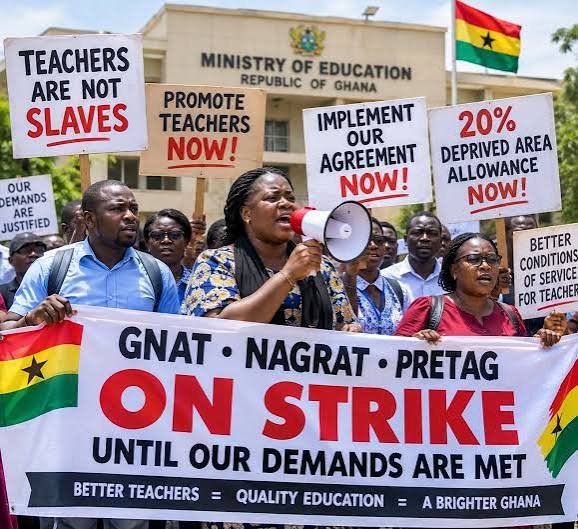
The strike may have ended, but the real test lies ahead. Beneath the announcement of improved allowances and promises of further negotiations lurks a troubling question: did teachers secure a genuine victory, or were they handed a cosmetic settlement dressed up as success?
In my previous article, I cautioned pre-tertiary educators that they had every reason to worry about the possibility of their union leaders negotiating their future away at the bargaining table. That warning was neither an attempt to discredit organised labour nor an exercise in needless pessimism. It was informed by precedents that should never be forgotten, particularly the history of agreements and arrangements negotiated in the name of teachers under successive governments.
Today, I return to that warning with an even stronger conviction: the outcome of Friday's negotiations has left me deeply suspicious that teachers may have sacrificed the substance of their demands for the appearance of a settlement. I hope time proves me wrong. I sincerely do. But hope must not silence scrutiny, and the announcement of improved allowances must not be mistaken for proof that the fundamental objectives of the strike have been achieved.
Teachers have endured enough disappointments to know that the difference between a victory announced at a press conference and a victory secured in an enforceable agreement can be enormous. And that is precisely why they must remain awake. Believe you and me, the gods do not always speak in words.
As a pantheist and a traditionalist in both belief and practice, I hold a profound conviction that the gods have their own ways of revealing what human beings might wish to conceal. Sometimes, the message is not delivered through grand declarations or dramatic pronouncements. It emerges through the smallest gestures, the unexpected reactions, and the moments when carefully managed appearances begin to unravel.
To the sceptic, such observations may sound inconsequential. To those who understand the worldview from which I speak, however, they are not necessarily trivial. I watched the conduct of the union leaders as they addressed the teachers whose interests they had been mandated to defend. I paid attention to their demeanour, their choice of words, their delivery and the reactions that accompanied their statements.
What I observed did not inspire the confidence that such a consequential moment demanded. Let me be clear: demeanour alone cannot establish that a bad deal has been struck. Neither can a moment of confusion prove that union leaders have deliberately betrayed their members. The substance of any agreement must ultimately be judged by its terms, its enforceability and its consequences for teachers.
Nevertheless, appearances can raise questions that deserve answers, particularly when the people being addressed have spent weeks making sacrifices in pursuit of clearly stated demands. And one particular moment caught my attention. Was it a call-off or suspension: a slip that raised questions.
In addressing the gathering, one of the union leaders reportedly described the strike as having been called off, rather than suspended. Another leader appeared to intervene physically, pulling at the speaker's clothing to draw his attention to the distinction. That moment, as seen in the footage, was striking.
Why did the distinction matter so much that an intervention became necessary in the middle of the address? The words call-off and suspension may sound interchangeable in ordinary conversation, but in an industrial dispute, their implications can differ depending on the resolutions adopted by the parties.
A suspension generally suggests that industrial action has been paused while specified matters remain outstanding or are pursued. Calling off a strike can also mean ending the action, but the precise consequences depend on the agreement and the terms communicated by the parties. The decisive question, therefore, is not simply which word a leader used on the podium. It is what the unions formally agreed to, what government committed to, and what happens if those commitments are not fulfilled.
If the strike was suspended pending further negotiations, teachers deserve to know the conditions attached to that suspension. If it was called off unconditionally, they deserve to know why that decision was justified despite the unresolved issues. And if the unions retain the right to resume industrial action should government fail to honour its commitments, that protection must be clearly established rather than left to interpretation.
For me, the exchange over the terminology was an unsettling moment. It reinforced my suspicion that the public announcement might not have conveyed the complete picture of what had transpired behind closed doors. I do not present that suspicion as proof of a secret agreement. I present it as a reason for teachers to demand the documents, explanations and assurances necessary to determine what was actually decided.
When the future of thousands of workers is at stake, clarity is not optional. Do not confuse improved allowances with victory. The most dangerous feature of a potentially unfavourable settlement is that it may not appear unfavourable at first. Announce an increase in allowances, emphasise the government's commitments and assure workers that other matters will continue to be pursued, and the immediate atmosphere can change dramatically.
Frustration gives way to relief. Suspicion yields to optimism. The pressure to continue demanding answers diminishes. And before long, workers who went into a dispute demanding comprehensive improvements may find themselves celebrating concessions that address only a fraction of their original concerns.
This is the possibility teachers must examine carefully. The reported commitment to implement a 20 per cent Deprived Area Allowance is significant if it is formally approved, adequately funded and implemented for eligible teachers. Likewise, the reported timelines for clearing promotion arrears could provide long-awaited relief to affected educators.
These are not achievements to be dismissed. But neither should they distract from the outstanding demand for comprehensive negotiations on a new Collective Agreement and improved conditions of service. An allowance is not a substitute for an entire Collective Agreement. A promise to clear arrears is not a substitute for addressing the structural conditions that led to the dispute. And an assurance that negotiations will continue proves not equivalent to an enforceable commitment to conclude them within an agreed timeframe.
Teachers must resist the temptation to celebrate the visible concessions while overlooking the potentially more consequential issues left unresolved.
What, precisely, has been agreed concerning the new Collective Agreement?
Has government committed to a definite negotiation timetable?
Have the parties agreed on the issues to be covered?
What happens if the Fair Wages and Salaries Commission continues to insist that it cannot undertake comprehensive negotiations during its reported transitional phase?
And what protection do teachers have if government fails to meet the deadlines it has announced?
Until these questions are answered, declarations of victory are premature.
We should be questioning whether the strike was worth the sacrifice. The two-week industrial action was not undertaken for its own sake. Teachers withdrew their services because they believed the outstanding grievances required decisive action. They expected the strike to compel government to address delayed promotion placements and arrears, implement the Deprived Area Allowance, and make meaningful progress towards improved conditions of service through a new Collective Agreement.
Industrial action carries consequences. Students lose instructional time, parents experience uncertainty, teachers face pressure, and the wider education system is disrupted. Workers do not ordinarily make such sacrifices merely to obtain another promise to negotiate. They do so because they believe the cost of inaction has become greater than the cost of confrontation.
That is why the outcome must be measured against the original objectives of the strike, not simply the number of concessions announced afterwards. If the two-week action secured enforceable commitments on all the principal demands, then the unions would have a strong case for declaring success. If it secured meaningful progress on some demands while leaving others subject to a credible, time-bound process, then it could reasonably be described as a partial victory.
However, if the strike ended without sufficient guarantees on the central conditions-of-service dispute, then teachers would have every reason to question whether their sacrifices achieved the intended purpose. The real measure of success is not whether the strike ended. It is whether the reasons for the strike have been adequately addressed. From where I stand, the unresolved questions are too serious to justify unqualified celebration.
Indeed, the lessons of the past must not be forgotten. My apprehension is also rooted in the precedents I discussed in my previous article. Teachers have witnessed arrangements negotiated in their name that subsequently generated questions about deductions from their allowances, the financial implications of programmes and the transparency of decisions affecting their professional welfare.
The One Teacher, One Laptop initiative remains a pertinent example. Under the cost-sharing arrangement, teachers were expected to contribute 30 per cent of the cost of their laptops, with the contribution linked to their Professional Development Allowance. The question was not whether teachers needed laptops. They did. The question was whether the financing arrangement represented the best possible deal for the teachers who were expected to bear part of the cost.
Likewise, the professional licensing system raises legitimate questions about recurring charges, renewal requirements, the services provided and the transparency of the arrangements. These examples do not establish that the present negotiations have produced another unfavourable agreement. But they demonstrate why teachers should not be expected to accept assurances without examining the substance of the arrangements made on their behalf.
A union leader's declaration that an agreement serves members' interests cannot replace the members' right to inspect and understand the agreement. Past disappointments should produce institutional learning, not permanent distrust. The way to restore confidence is through transparency, consultation and demonstrable results.
If the present settlement is genuinely favourable to teachers, the unions should have no difficulty explaining its terms and publishing the commitments necessary to verify its success. To me, the gods have spoken; now let the documents speak. My traditional beliefs lead me to interpret certain moments as signs worthy of attention. That is my personal conviction, and I do not expect every reader to share it.
But there is a broader point that should unite believers and sceptics alike: when circumstances raise reasonable doubts about a consequential decision, the responsible response is to investigate rather than dismiss the concerns.
The apparent confusion over whether the strike was called off or suspended should prompt a request for clarification. The announcement of improved allowances should prompt questions about implementation. The promise of further negotiations should prompt demands for a timetable. And the decision to end or suspend industrial action should be examined against the terms of the resolution adopted by the unions.
If the agreement is sound, scrutiny will confirm it. If it is inadequate, scrutiny will expose the gaps that need to be addressed. Either way, teachers will be better served by transparency than by speculation, silence, or blind loyalty.
The gods, in my worldview, may reveal what appearances conceal. But in the public arena, documentary evidence must establish what was agreed and who is responsible for fulfilling it. That is the standard by which the present settlement must be judged.
Teachers must not go to sleep, and my warning remains unchanged. Teachers must not allow the relief of returning to the classroom to extinguish their vigilance. They must not assume that the announcement of an allowance increase means their long-term conditions of service have been secured. And they must not surrender their right to question their representatives simply because the leaders have announced an outcome.
The unions owe their members a comprehensive account of the negotiations. They should clarify the formal status of the strike, publish or communicate the material terms of the settlement, identify the issues that remain outstanding and explain the steps being taken to secure a new Collective Agreement. They should also make clear what options remain available if government fails to fulfil its commitments.
This is not an invitation to undermine union leadership. It is a demand that leadership meets the standards required of those entrusted with the welfare of others. Indeed, if the unions have secured a favourable settlement, transparent communication will strengthen their credibility. But if critical issues remain unresolved, teachers deserve to know that too. The worst outcome would be for teachers to discover months from now that the victory they celebrated was far less substantial than they were led to believe.
Time will tell as you sail with me! I have expressed my concerns because I believe the stakes are too high for silence. I may ultimately be proved wrong. The government may honour every commitment, the Deprived Area Allowance may be implemented as promised, the promotion arrears may be paid within the announced deadlines, and comprehensive negotiations may deliver substantial improvements in teachers' conditions of service.
If that happens, I will have every reason to acknowledge the outcome. But if the deadlines pass without fulfilment, if the new Collective Agreement remains indefinitely deferred, or if teachers discover that the settlement offers little protection for their long-term interests, then the questions being raised today will become even more urgent. For now, teachers must watch, question, and demand accountability.
The pregnant woman who has reached her time cannot indefinitely conceal the outcome of her pregnancy. Eventually, what has been developing in private becomes visible to everyone. So it is with negotiations.
Time will expose the substance of this settlement. Until then, teachers should neither panic nor celebrate blindly. They should insist on the facts, insist on transparency, and remain prepared to defend the interests that brought them to the negotiating table in the first place.
The gods, as I believe, do not lie. But in this matter, let the signed agreements, the implementation records, and the teachers' payslips have the final word. The strike may be over, but the verdict on its success is still pending.






No comments yet. Be the first to comment!