
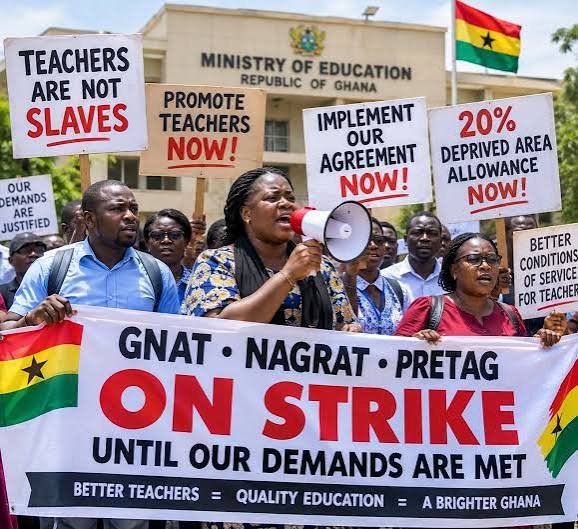
The Ghanaian teacher must not go to sleep now. If anything, this is the moment to remain vigilant, scrutinise every development, and hold union leaders accountable for every decision taken in the name of teachers. The industrial action has brought the government to the negotiating table, commitments have reportedly been made on some of the outstanding demands, and the Council of State has now invited the leadership of the country's three principal pre-tertiary teacher unions to a meeting.
Yet, beneath these promising developments lies a question that should concern every teacher: The unions have demonstrated their bargaining power, but will their leaders stand firm or surrender the future of the profession at the negotiating table? The strike may have forced government to make concessions, but the real test lies ahead: securing an enforceable Collective Agreement without sacrificing teachers' long-term interests.
The Ministry of Labour, Jobs and Employment's letter dated October 8, 2026, invites the leadership of the Ghana National Association of Teachers (GNAT), the National Association of Graduate Teachers (NAGRAT) and the Pre-Tertiary Teachers' Association of Ghana (PRETAG) to a meeting on Friday, October 9, to discuss the implementation of interventions towards resolving the strike and related matters.
The invitation signals that the dispute has attracted attention at a level where the search for a resolution is being pursued through further intervention. That development should ordinarily inspire confidence. However, for teachers who have endured repeated disappointments over their conditions of service, reserved optimism is more appropriate than unconditional celebration.
The question is not whether dialogue is necessary. It is whether the dialogue will produce concrete, enforceable commitments that protect teachers' interests beyond the immediate crisis.
The strike has yielded ground, but the battle is not over. One cannot fairly dismiss the significance of the industrial action or the pressure it has brought to bear on government. Before the strike, teachers' concerns over promotion arrears, the proposed Deprived Area Allowance and the delayed negotiations for a new Collective Agreement had generated considerable frustration.
Now, there are reported commitments on two of these fronts. First, government has committed to implementing a 20 per cent Deprived Area Allowance for teachers serving in rural and hard-to-reach communities, with provision expected to be made in the upcoming budget cycle.
Second, the government has reportedly committed to a timeline for clearing the backlog of salary-scale placements and promotion arrears affecting teachers promoted in 2025. Initial disbursements were targeted for October 15–16, 2026, with October 30 set as the final deadline. The records of approximately 52,000 teachers were reportedly undergoing validation by the Controller and Accountant-General's Department following data processing by the Ghana Education Service.
If these commitments are implemented as stated, they will represent meaningful progress. Teachers who have waited for the financial benefits of promotion deserve to receive them, including the arrears properly due to them. Likewise, teachers serving in deprived communities deserve a transparent and reliable system of compensation that recognises the difficulties associated with their postings.
But a commitment is not the same as implementation. A deadline is not a payment. And an announcement of an allowance is not the same as an operational policy with clear eligibility criteria, an approved funding mechanism, and a commencement date.
Teachers must therefore continue to demand evidence of implementation rather than celebrate promises prematurely. The unions must insist that the reported commitments be documented, communicated to their members and monitored until they are fulfilled. The strike must produce results that teachers can verify in their payslips, not merely assurances they can read in press statements.
The real danger lies in the Collective Agreement. While the promotion arrears and Deprived Area Allowance have attracted attention, the third issue may ultimately prove the most consequential: the negotiation of a new Collective Agreement and improved conditions of service.
This is where the real test of union leadership begins. The Collective Agreement is not a peripheral administrative document. It is the framework through which teachers' employment conditions, benefits, entitlements, and other workplace arrangements are negotiated and formalised.
Its importance extends far beyond the immediate payment of arrears or the introduction of a particular allowance. A well-negotiated agreement can establish lasting improvements in teachers' welfare. A poorly negotiated one can leave teachers trapped in unfavourable conditions for years.
Reports of inconclusive engagements between the unions and the Fair Wages and Salaries Commission (FWSC) are therefore troubling. The explanation reportedly offered — that the commission is undergoing a transitional phase and cannot engage in holistic negotiations for entirely new conditions of service — raises serious questions about the government's preparedness to address the unions' concerns. It is flimsy and bogus, if you ask me.
The reported position that the unions should concentrate on improving existing allowances instead of undertaking comprehensive negotiations is especially alarming. Why should an institutional transition become an obstacle to progress on teachers' conditions of service?
If the commission is undergoing a transitional phase, what arrangements have been made to ensure that negotiations affecting hundreds of thousands of teachers are not indefinitely delayed? Who bears the consequences of the transition? Certainly not the officials who can invoke administrative processes to explain the delay. It is the teacher who continues to work under existing conditions while waiting for an agreement that may improve his or her professional and financial circumstances.
A transitional arrangement may present legitimate administrative challenges. But it should not become a convenient excuse for indefinite postponement. Government must clarify the procedural and legal basis of the FWSC's reported position, identify the outstanding issues and provide a credible timetable for substantive negotiations. Teachers cannot be expected to accept administrative explanations as substitutes for progress.
The baffling thing is: Why summon the unions when government holds the key? The invitation to the unions for a meeting is not inherently objectionable. Mediation and high-level intervention can help break an impasse when direct negotiations have stalled. Nevertheless, the choice of participants and the purpose of the meeting matter.
If the principal obstacle concerns the FWSC's readiness to engage in comprehensive negotiations, should the intervention not focus directly on the commission and the government authorities responsible for resolving that impasse?
The separate letters from the Council of State and the Ministry of Labour, Jobs and Employment invite the union leaders to discuss the status of interventions towards resolving the strike and related matters. It does not, by itself, establish that the unions have been asked to surrender any of their demands. Nor does it establish the precise role the Council of State will play in the process.
Yet the invitation raises an important question of strategy: Will the intervention compel government to move beyond procedural excuses, or will the unions be persuaded to lower their demands in the name of industrial harmony? That is the concern teachers must take seriously.
A successful intervention should not merely persuade organised labour to call off its strike. It should address the reasons the strike became necessary in the first place. If the unions are summoned to a meeting while the underlying dispute remains unresolved, the process must not become an exercise in placing pressure on labour to compromise simply because the country needs industrial peace.
Industrial peace is desirable, but peace without justice is fragile. A settlement that sends teachers back to the classroom without securing a credible pathway to improved conditions of service would postpone the crisis rather than resolve it.
The Council of State's intervention should therefore be directed towards securing a meaningful commitment from government, including the FWSC, to resume substantive negotiations within a clearly defined timeframe. The objective must be a fair settlement, not merely a convenient announcement that the strike has ended.
The wake-up call is that union leaders must not repeat the mistakes of the past. My apprehension about this stage of the negotiations is not born of hostility towards organised labour. It arises from the need to distinguish between the interests of union leadership and the interests of the ordinary teacher.
The leadership of GNAT, NAGRAT and PRETAG has demonstrated the collective bargaining power that organised teachers can wield when they act together. The present industrial action itself illustrates the significance of that leverage.
However, possessing bargaining power is not the same as using it optimally. Teachers have legitimate reasons to demand greater transparency over past agreements and initiatives negotiated in their name, including the One Teacher, One Laptop programme and the deductions associated with professional licensing.
In the laptop initiative, teachers were required to contribute 30 per cent of the cost of their devices, with the contribution linked to their Professional Development Allowance. The unions participated in negotiating that cost-sharing arrangement. The question remains whether the arrangement represented the best possible outcome for teachers and whether the financial implications proved adequately explained to the membership.
Similarly, professional licensing may serve legitimate regulatory and professional-development purposes. But recurring financial obligations associated with licensing and renewal must be supported by transparent explanations of the applicable rules, costs and benefits. Teachers are entitled to understand what they pay for, why they pay for it, and how the arrangements benefit them professionally.
These concerns do not establish that union officials personally profited from the schemes. But, hey, they did profit heavily at the expense of the teachers they led then. One will rather say they reinforce a fundamental principle: agreements negotiated in the name of teachers must withstand scrutiny by teachers. To me is the cosmetics!
In all this, it is precisely because union leaders possess enormous influence over the professional and financial welfare of their members that they must exercise that influence with exceptional care. The present negotiations must not become another episode in which teachers are asked to trust their representatives without knowing the full implications of the compromises being considered.
The determination demonstrated through the industrial action deserves recognition, however. By sustaining collective pressure over outstanding grievances, the unions have compelled renewed engagement with government and helped place teachers' demands firmly on the national agenda. In that sense, one might say the unions have attempted what Napoleon could not do: they have brought a formidable force into a contest in which the outcome was far from assured.
But the metaphor carries a warning. The ability to mobilise teachers and bring the education system to a standstill is only one measure of union strength. The more important measure is whether that strength translates into durable improvements in teachers' conditions of service. It would be a grave mistake to interpret the reported commitments on promotion arrears and the Deprived Area Allowance as proof that the entire struggle has been won.
The most consequential negotiations may still lie ahead. If the unions surrender their demand for substantive negotiations on a new Collective Agreement in exchange for commitments that address only immediate grievances, they risk securing short-term relief while leaving the structural problems of teachers' welfare untouched. Such an outcome would be especially disappointing after the sacrifices teachers have made during the strike.
Union leaders must therefore remain focused, disciplined and mentally prepared to withstand pressure from every direction. They must understand that government has an interest in restoring normal school operations, just as teachers have an interest in returning to their classrooms. But these interests should converge around a fair settlement, not around an arrangement that prioritises the resumption of work over the resolution of legitimate grievances.
Teachers should demand from their leaders, especially at a critical juncture like this, that they must not remain passive spectators. The invitation to a high-level meeting should be a reason for heightened vigilance, not complacency. Teachers should insist on at least five safeguards.
First, a written commitment to comprehensive negotiations. The unions must seek a clear undertaking that negotiations on the new Collective Agreement will commence or resume within a specified timeframe, with an agreed process for resolving outstanding matters.
Second, an enforceable implementation schedule. The reported October deadlines for promotion placements and arrears must be monitored, with transparent updates on the validation of records and payments to eligible teachers.
Third, clarity on the Deprived Area Allowance. The 20 per cent commitment must be translated into a documented policy identifying eligibility, commencement, funding and payment arrangements.
Fourth, transparency over compromises. If any proposal requires the unions to defer, modify or abandon a demand, the leadership must explain the implications to members. Major concessions affecting teachers' long-term conditions should not be accepted without appropriate consultation and accountability.
Fifth, regular communication with the membership. Teachers must receive accurate accounts of what was discussed, what government committed to, which issues remain unresolved, and what the unions intend to do next. These safeguards would not obstruct mediation. They would strengthen it by ensuring that the outcome enjoys the confidence of the people whose livelihoods are at stake.
Government must stop treating teachers' patience as an unlimited resource. Understand it this way! The responsibility for resolving the impasse does not rest with union leaders alone. Government must also demonstrate sincerity.
It cannot consistently call for industrial harmony while allowing issues affecting teachers' salaries, promotions and conditions of service to remain unresolved for extended periods. Neither can it expect unions to abandon industrial action merely because a high-level meeting has been convened.
The appropriate response is to engage substantively, acknowledge legitimate outstanding commitments and establish a credible path towards implementation. If the FWSC faces genuine institutional or procedural constraints, those constraints should be explained transparently and addressed through the appropriate channels. They should not become a permanent barrier to negotiations.
The education sector requires stability, but stability cannot be built on the expectation that teachers will indefinitely absorb the consequences of delayed decisions. Teachers are professionals whose work underpins the country's human-capital development. Their welfare should be treated as a national priority rather than an administrative inconvenience.
The final test is what teachers take home. Ultimately, the success of this intervention will not be measured by the number of meetings held, the seniority of the officials present, or the language used in official communiqués.
It will be measured by results. Have eligible teachers received their promotion arrears? Has the Deprived Area Allowance been formally implemented and paid? Have substantive negotiations on the Collective Agreement progressed? Have the outstanding conditions of service been addressed through a credible and transparent process? And have union leaders secured an outcome that improves teachers' welfare without sacrificing their long-term interests?
These are the questions that must guide the assessment of the present process. The Council of State's involvement may provide an opportunity to break the deadlock. The government's reported commitments may represent meaningful progress. And the unions' collective action may have created the leverage necessary to secure further concessions.
But none of these developments justifies lowering our guard. Teachers must remain awake, because the future of their profession cannot be entrusted to assurances alone. The union leaders must go into the meeting with a clear mandate, firm resolve and an unfaltering commitment to the membership they represent. They must be prepared to negotiate, but not to surrender the substance of their demands merely to secure a convenient settlement.
Government, for its part, must recognise that the purpose of mediation is not to defeat organised labour. It is to resolve the issues that made confrontation necessary. The ultimate objective must be a settlement that protects teachers' immediate entitlements while laying a firm foundation for better conditions of service.
The strike has opened a window of opportunity. Whether that opportunity becomes a turning point or another chapter in the history of deferred promises depends on the decisions made now. Let the leaders negotiate with wisdom, but let them never forget whose future they hold in their hands. For Ghana's teachers, this is no time to sleep.





Abu Kalaa Abraham
Oct 9, 2026 9:13 amThat's a great piece.