
Somewhere along the coast, where the Atlantic meets the land, history still lingers in the silence. It lingers in the wind, in the memory of departures that were never meant to return, in the weight of a past that refuses to settle. And yet, even now, we attempt to explain it away.
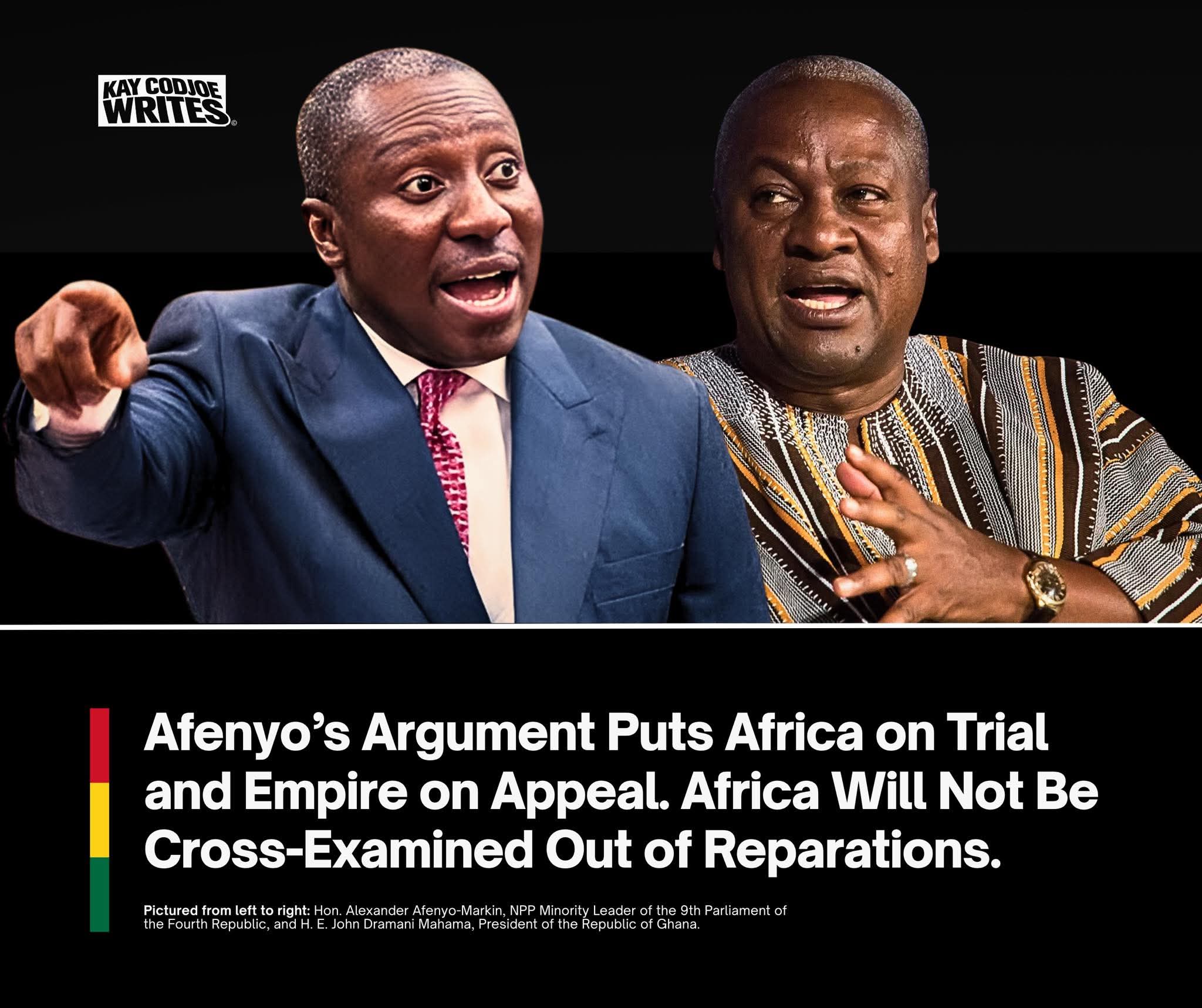
Some critics have argued that the call for reparatory justice over the Transatlantic Slave Trade is weakened because Africans themselves participated in it. Ghana’s minority leader, Hon. Alexander Afenyo-Markin, has stated this plainly, arguing that indigenous involvement complicates, if not undermines, the moral basis for reparations.
That argument has arrived at a curious moment. Even as elements within his own political tradition rush to apportion credit between President John Mahama and former President Akufo-Addo for this historic diplomatic breakthrough, the deeper significance of the moment is being quietly diluted. Some of us had hoped for something higher, a gesture of national continuity, perhaps even a simple courtesy visit from the president to his predecessor, to affirm that this was not a partisan victory but an African one.
But instead, we are offered a familiar refuge. The reduction of history into fragments. The comfort of half-truths. The illusion that complexity erases responsibility. At first hearing, the argument sounds balanced. It appeals to fairness. It invites us to believe that if Africans were involved, then the burden of history must be evenly shared. But history does not work that way. Participation is not authorship.
Involvement is not equivalence.
Presence is not power. And any argument that collapses those distinctions is not clarifying history. It is obscuring it.
Begin with what has now been formally recognised. On March 25, 2026, the United Nations General Assembly declared the trafficking of enslaved Africans and racialised chattel enslavement the gravest crime against humanity. This was not symbolic language. It was a statement about scale, structure, and consequence. It tells us that what happened was not a series of isolated exchanges. It was a system. Organised. Sustained. Profitable. And systems must be understood at the level at which they operate.
Before the Atlantic trade expanded, forms of servitude existed across many societies, including in Africa. That is true. But those systems were not designed for mass export across oceans. They were not built on rigid racial hierarchies. They did not convert entire populations into inheritable property.
The Atlantic system changed all of that. From the 15th century onwards, European expansion fused commerce, law, and race into something new. Ships crossed oceans not occasionally, but continuously. Plantations in the Americas did not require labour in moments but in perpetuity. Laws were written to ensure that Blackness itself became a condition of enslavement, passed from one generation to the next. This did not emerge from African societies. It was imposed through a global economic design.
The numbers tell the story without sentiment. According to the Slave Voyages Database, about 12.5 million Africans were forced onto ships. Roughly 10.7 million survived the crossing. Close to 2 million died at sea. Many more died before ever reaching the coast. This was not trade as exchange.
It was extraction at scale.
Now, within that system, Africans participated. Some rulers traded. Some resisted. Some tried to regulate what they could no longer control. Along the Gold Coast, coastal brokers, debt practices such as panyarring, and shifting alliances around the forts reveal that African involvement was real but hardly uniform, autonomous, or equal in power to the Atlantic system that drove demand. That detail matters.
Because it shows that what is often presented as simple participation was, in many cases, shaped by pressure, distortion, and intrusion. External demand changed internal incentives. Trade goods, including firearms, altered balances of power. In parts of West Africa, access to weapons became tied to the supply of captives. Conflict intensified. The system fed itself. This was not a neutral marketplace of equals. It was a structure that reshaped behaviour.
Law understands this distinction clearly. Under frameworks governing crimes against humanity, including principles reflected in the Rome Statute of the International Criminal Court, responsibility does not attach equally to everyone who appears within a system. It attaches most heavily to those who organise, direct, and benefit from it at scale. The presence of intermediaries does not dissolve that responsibility. It confirms the system. And the system produced outcomes.
The wealth generated from enslaved labour did not remain in Africa. It accumulated in European ports, banks, and industries. It financed expansion, industrialisation, and state power. When abolition came, the British state compensated slave owners, not the enslaved, to the tune of £20 million, a fact documented in projects like Legacies of British Slave Ownership. That is where the value went.
Africa, by contrast, absorbed the loss. Population depletion. Political instability. Long-term structural disruption. These are not abstract claims. They are historical consequences. Reparatory justice speaks to that reality. It is not a reward for innocence. It is a response to structure. It asks a different set of questions.
Who designed the system? Who scaled it? Who profited from it? Who continues to benefit from its legacy?
The argument that African participation cancels reparations avoids those questions. It replaces them with something easier. It confuses involvement with equivalence. But history, law, and political economy do not support that confusion. When examined properly, the Transatlantic Slave Trade is not a loose network of actors sharing equal responsibility. It is a coordinated system with identifiable centres of control and accumulation. That is what the United Nations General Assembly has now recognised. Not a simplified story. A structured reality.
African participation remains part of that history and must be acknowledged. But it does not settle the question. Because the question was never whether Africans were involved. The question is who built the system, who benefited most from it, and who still stands on its foundations today. That is where the argument for reparatory justice begins and that is where it must remain.



No comments yet. Be the first to comment!