
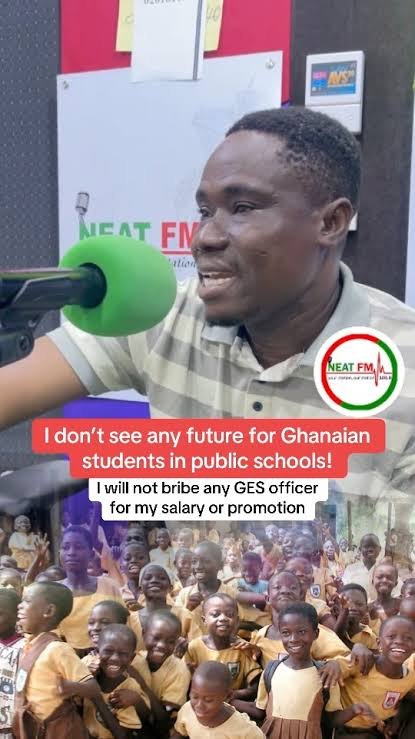
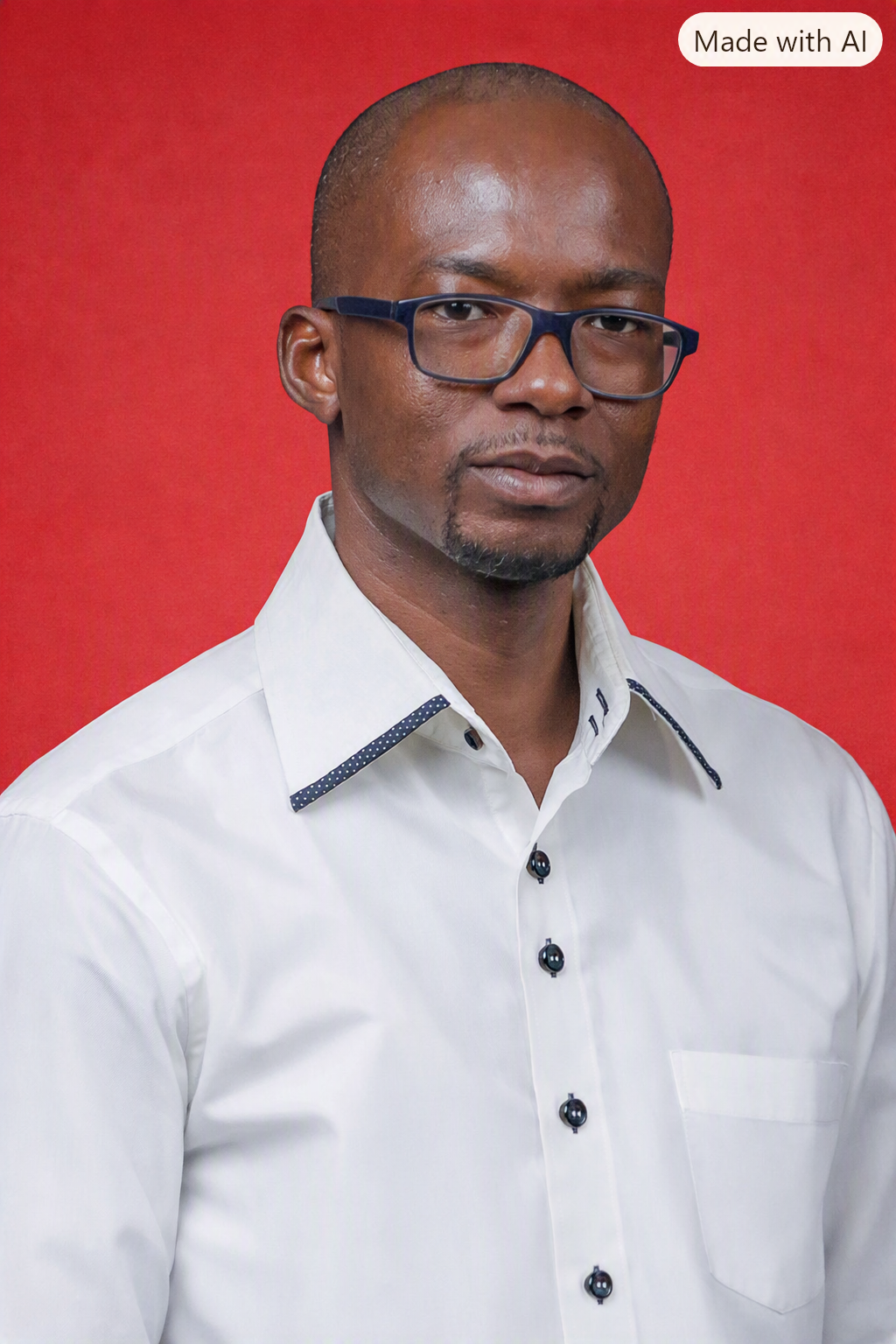
The teacher is the bedrock of national development, but what happens when the teacher can no longer afford to remain in the classroom? A chilling narration and perspective from Francis Logah, a trained Ghana Education Service (GES) teacher turned commercial motor rider (Okada), in a notable interview on NEAT 100.9 FM.
There are some testimonies that should not be dismissed as the ordinary complaints of disgruntled workers. They must be interrogated as symptoms of a deeper national condition. The latest testimony of a professional teacher who abandoned the classroom for commercial motorcycle riding—popularly known as Okada—belongs to that category. His story is uncomfortable. It is painful. But above all, it is instructive.
Having previously explained why he left the teaching profession, the former teacher has returned to reaffirm his position, this time offering an even more revealing account of the economic circumstances that informed his decision. He says that during approximately six years of active teaching service, he could not afford to lay even a single block towards a building from his earnings as a Ghana Education Service employee. He eventually left teaching around 2022.
Then came the revelation that makes his story particularly compelling: a piece of land left to him by his mother became the foundation upon which his new economic life was built, and through his Okada business, he was able to develop it into a two-bedroom house.
One may disagree with his choice. One may question his conclusions. One may even challenge some of his generalisations. But it would be intellectually irresponsible to dismiss the question his experience raises. Why should a professionally trained teacher find it economically more feasible to leave the classroom and ride a motorcycle for a living? That is the question Ghana must answer.
The Okada rider is not the real story, or the temptation will be to make the man himself the story. It should not be, but what he represents in the narration. He represents a category of educated Ghanaians who entered the teaching profession with qualifications, expectations and a commitment to educating the next generation, but who subsequently discovered that professional status does not necessarily translate into economic security. His motorcycle is therefore only the visible symbol.
The deeper issue is the economics of teaching. He is essentially telling Ghana: I tried the noble profession. I experienced it from inside. I eventually discovered that I could not build a meaningful economic life from it. That testimony deserves serious policy attention. Not because every teacher must become a homeowner within 1 year, though a big issue for teachers in Ghana to own an apartment.
Again, not because salary alone should determine professional satisfaction and certainly not because teaching should be reduced to a money-making enterprise. But all these are important to the Ghanaian teacher in all respects. What is striking is that any nation cannot sustainably build human capital on the economic exhaustion of the people responsible for producing it. No two ways about it.
We keep changing the curriculum but overlook the human being implementing it. Ghana has repeatedly reformed its educational curriculum by pursuing competency-based approaches, curriculum restructuring, digital-literacy ambitions, and various reforms designed to prepare young people for the demands of the 21st-century. The Ministry of Education itself describes the Education Strategic Plan 2018–2030 as part of the effort to transform teaching and learning and improve educational outcomes.
The basic-education system figures, comprising only 42,543 public basic schools serving 6,154,953 learners as of 2024, are staggering. But behind every curriculum document and educational reform is a teacher. Behind every textbook is a teacher who must interpret it, just as behind every digital-learning initiative is a teacher who must deploy it. Yes, and indeed, behind every competency-based learning objective is a teacher who must transform it from policy language into something a child can understand.
Amid all this, Ghana's development conversation becomes paradoxical herein. We keep redesigning the educational system while failing to redesign the socio-economic conditions under which the teacher is expected to operate. What good is a 21st-century curriculum if the teacher implementing it is still struggling to obtain basic instructional resources? What is the point of demanding digital literacy if the teacher cannot reliably access the technology required to deliver digitally oriented lessons? What is the value of constantly revising curricula if the welfare and professional conditions of the person delivering the curriculum remain an afterthought? A curriculum does not teach a child. A teacher does.
The most disturbing part of his testimony is not the Okada but the account that teachers may actually be buying food on credit. He reportedly spoke of market women maintaining books in which they record teachers who take foodstuffs on credit and wait for their monthly salaries before settling their debts. This is a powerful indicator of household financial stress, and the image is difficult to ignore:
The teacher educates the children of the nation during the day. The teacher goes home worrying about food, rent, transportation, school fees and other household obligations. The teacher waits for payday. The trader waits for the teacher's salary. And the cycle repeats itself.
This is not an argument against market women. Far from it. The market woman may herself be providing an informal social safety net to a public servant whose monthly income does not stretch far enough. When the informal trader becomes the creditor keeping the professional teacher's household afloat, the country needs to ask whether its wage structure has become disconnected from the cost of living.
The Labour Act raises an important debate here with a legal dimension. Ghana's Labour Act, 2003 (Act 651), states among the duties of an employer that the employer should provide work and appropriate raw materials, machinery, equipment and tools. It also places a duty on employers to take practicable steps to ensure workers are free from risks of personal injury or damage to health in the course of employment.
That provision is important when discussing the persistent expectation that teachers should personally finance some of the resources required for effective teaching. The question is not whether teachers should sometimes demonstrate initiative. They should. The question is whether initiative has gradually been converted into an unofficial requirement for teachers to subsidise the public education system from their personal earnings.
There is a difference. A teacher purchasing occasional teaching materials out of personal commitment is one thing. A system structurally depending on teachers' personal finances to compensate for inadequate institutional provision is something else entirely. The latter is unsustainable.
The laptop controversy should have taught us something, but have we? Ghana has already experienced the controversy surrounding the One Teacher, One Laptop initiative. The initiative was presented as part of the effort to equip teachers for digital teaching. Yet teachers were required to make a contribution towards the devices, generating considerable debate about whether workers should bear part of the cost of equipment necessary for their professional duties.
The controversy was not merely about laptops. It was about philosophy. When the state introduces a technological requirement into public education, who should carry the cost of meeting that requirement? That question remains relevant today. The Labour Act's provision concerning an employer's duty to provide appropriate equipment and tools makes the debate even more consequential. If Ghana wants 20st-century education, it must be prepared to finance the infrastructure and tools that make 20st-century teaching possible. A teacher cannot be expected to manufacture a digital classroom out of a salary already struggling to sustain a household.
Honestly, successive governments must accept their share of responsibility as the other twist to this discussion. Ghanaian political parties have become remarkably good at competing over the ownership of educational achievements. When an educational intervention succeeds, political communicators compete over who conceived or mooted it, who introduced it, who funded it, who launched it, who expanded it, and who deserves the credit.
But with nonchalance, when the teacher complains about conditions of service, the same political enthusiasm often disappears. This is where the politics of education becomes problematic. Education should not merely be an arena for political credit. It should be a long-term national investment insulated, as much as possible, from partisan competition.
The Free SHS policy, curriculum reforms, school infrastructure, teacher recruitment, digitalisation, TVET expansion and other initiatives may all have political ownership and historical significance. But none of them should become substitutes for addressing the socio-economic condition of the teacher. The child must not become the only beneficiary of education policy while the teacher becomes its forgotten casualty.
The gradual descent into Ghana's underdevelopment begins here and cannot be attributed to teacher welfare alone. That would be intellectually simplistic. Our development challenges are multidimensional: weak productivity, infrastructure deficits, fiscal constraints, unemployment, corruption, institutional weaknesses, limited industrial capacity, inadequate investment and other structural problems all matter. But there is one factor that connects virtually all of them: human capital, and it begins with education.
The engineer begins somewhere, and so do the doctor, scientist, entrepreneur, economist, politician, judge, university professor, you name it. And before many of them encounter the university lecturer, they encounter the teacher. This is why the teacher is not simply another public employee. The teacher is the foundation upon which the rest of the professional pyramid is constructed. If the foundation is weakened, the structure eventually becomes unstable.
The tragedy is that we know this—and still act otherwise. Ghana does not lack education policies. It does not lack curriculum reforms, likewise committees, strategic plans, conferences, and speeches about the importance of teachers. What appears to be missing is sufficient consistency between our rhetoric and our resource allocation.
The Ministry of Education itself acknowledges the enormous scale of the public basic-education system and the central role of teachers and teaching materials in delivering it. The question is whether our budgetary and institutional choices adequately reflect that reality. Because education is not transformed by policy documents alone. It is transformed when the teacher walks into the classroom with the tools, confidence, security, training and professional dignity necessary to teach effectively.
In all this, what does the Okada rider want us to hear? His message, stripped of its anger and frustration, is actually very simple: A profession cannot survive indefinitely on nobility. Teachers have families; they pay rent, eat, travel, build houses, educate their own children, become sick, and eventually retire. Teachers need financial security, and they have the right to aspire to a decent standard of living.
There is absolutely nothing unprofessional about demanding economic dignity. Indeed, if the teacher cannot achieve some measure of economic stability through legitimate professional employment, society should not be surprised when alternative occupations begin to look more attractive. That is precisely what the former teacher's story represents.
Government must stop treating teacher welfare as an afterthought. The answer is not simply another salary increment. Ghana requires a comprehensive teacher-welfare architecture, and that should include: competitive remuneration that reflects actual living costs; meaningful incentives for teachers serving in deprived and difficult areas; realistic accommodation arrangements for teachers posted away from their homes; reliable provision of textbooks and instructional materials; and adequate digital and ICT infrastructure.
The rest include: professional development that does not simply shift costs back onto teachers; timely promotions and placement; meaningful protection against violence in schools; accessible housing and mortgage schemes; affordable vehicle and emergency loans; credible retirement and investment arrangements; and stronger accountability and bargaining effectiveness from teacher unions. The goal should be straightforward: A teacher should be able to remain a teacher without being condemned to perpetual economic vulnerability.
The teacher unions also have a historic responsibility in that government cannot be the only target. Teacher unions must also look inward, and if thousands of teachers pay dues every month, those dues must translate into visible collective strength. The unions must negotiate aggressively, communicate transparently, publish progress on agreements, defend teachers when commitments are breached, and develop innovative financial and welfare mechanisms for members (the Teachers’ Bank comes to mind).
They must demonstrate that union leadership is not an end in itself but a fiduciary responsibility to the ordinary teacher. The teacher needs representatives who can sit across the negotiating table from government and make it impossible for the concerns of teachers to be relegated to the margins. I cannot be one, else….
The 2027 Budget should therefore be a test for all teachers, and the wider public should look beyond the headline figures. The relevant question will be: What has the government done to make teaching economically and professionally sustainable? Not merely what has been spent on education or how many schools have been constructed, or how many students have benefited from an educational programme, or who deserves political credit. But: What has been done for the person who must make all these investments work? The teacher.
We should not wait until the teacher disappears. There is an old African wisdom that says that when a child is told that his mother is dead but insists that she is merely sleeping, reality eventually becomes unavoidable when other children return home to mothers who can walk, speak and embrace them. That is where Ghana's education system must be careful not to find itself.
We cannot continue telling ourselves that everything is fine because the teacher is still showing up. The teacher showing up does not necessarily mean the teacher is thriving. The teacher standing in front of the classroom does not mean the teacher is financially secure. The teacher completing lesson notes does not mean the teacher has no economic distress. And the teacher remaining silent does not mean the system is healthy.
Perhaps the former teacher who now rides an Okada has done Ghana an unexpected favour. He has broken the silence. He has forced the country to look at the uncomfortable side of the teaching profession. His story may not represent every teacher. It certainly does not invalidate the commitment of the thousands of teachers who continue to serve faithfully. But it represents a warning, and Ghana would be foolish to ignore it.
Because the question before us is not whether an individual teacher has chosen to ride an Okada. The real question is: What kind of country makes a professionally trained teacher conclude that riding an Okada offers a better economic future than educating the children of that country?
Until we answer that question honestly, we will continue to reform curricula without reforming the conditions of the people who implement them. We will continue celebrating educational achievements while overlooking educational workers. If care is not taken, we will continue to produce policies without adequately empowering their implementers. Perhaps, the looming danger will be continual weakening of our very foundation upon which national development rests.
The teacher is the bedrock of every nation, and if it is neglected, cracks will eventually appear throughout the structure. And when those cracks become too large to repair cheaply, no government will be able to claim that it did not see them coming.




No comments yet. Be the first to comment!