
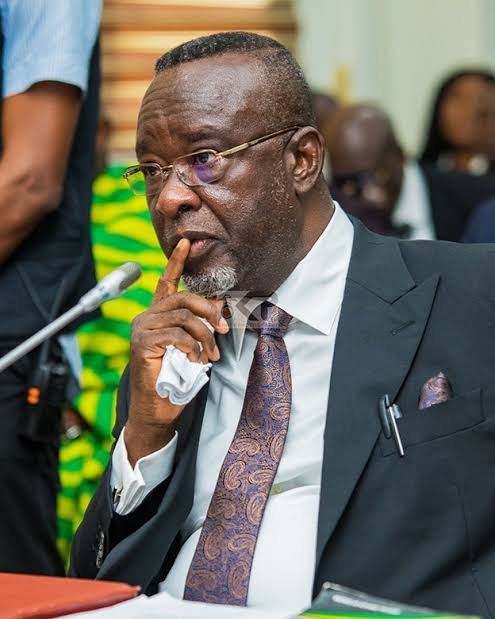
The controversy surrounding the recent words of Chief Justice Paul Baffoe-Bonnie demands a more intellectually honest study than the political outrage currently following it, without any spark of patriotism and nationalism in the opiate. Not everything we see or hear from a public official is necessarily what that person ought to have said, but neither should every unpleasant statement be seen as an unforgivable sin. This appears to be at the heart of the criticism being aimed at the CJ, particularly following his remarks apparently made during a recent meeting with various state entities.
During visits to the Social Security and National Insurance Trust (SSNIT) and the Minerals Income Investment Fund (MIIF) on September 2, 2026, the Chief Justice welcomed what he described as advances in the performance of some government institutions. In doing so, he questioned what Ghana had been doing over the prior eight years and, referring to SSNIT's stated discussion of disposing of some assets, remarked that one could wonder how Ghana had "sunk so low." He subsequently encouraged the administrators of MIIF to help assure the success of President John Dramani Mahama's development plan.
The CJ's words have sparked incandescent wrath in certain quarters, especially among members and sympathisers of the NPP, who appear to believe that he crossed a line that ought not to have been crossed. The NPP naturally took objection to these remarks and contends that it is not wholly without merit given the Chief Justice occupies a constitutionally sensitive job. They contend that public confidence in the Judiciary depends not only on actual impartiality but also on the perception of impartiality. The party has consequently contended that comparing political commentary by the President of the Judiciary can generate the perception that the institution has become associated with the current administration.
That worry should not simply be dismissed. The 1992 Constitution expressly safeguards the independence of the Judiciary. Article 127 provides that, in exercising judicial power, the Judiciary is subject only to the Constitution and must not be subject to the control or direction of any person or authority. The constitutional Judicial Oath also requires judicial officers to perform their functions without "fear or favour, affection or ill-will" and to uphold and defend the Constitution and laws of Ghana.
Consequently, it is legitimate to ask whether a Chief Justice should be particularly circumspect when commenting on the relative performance of successive political administrations. But that legitimate question is fundamentally different from the proposition that the Chief Justice has thereby ceased to be politically neutral. Those are two different claims, and intellectual honesty requires that we do not conflate them.
A public statement can be ill-advised without constituting political capture. A statement can be politically consequential without being politically motivated. And a statement can be factually defensible while still being inappropriate for the office from which it was made. That distinction is crucial. The more interesting question, therefore, is not simply, "Was the Chief Justice right or wrong to say it?" It is: What standard are we applying, and would we apply the same standard if the political circumstances were reversed? This is where Ghana's political culture confronts us with an uncomfortable problem.
We have developed an extraordinary capacity for selective principle. When a public official makes a statement favourable to our political tradition, we are often prepared to describe it as courage, patriotism, truth-telling or speaking "as a Ghanaian." When the same kind of statement is perceived as damaging to our political tradition, we suddenly rediscover institutional propriety, constitutional convention and the dignity of public office. That is not principle. It is partisanship masquerading as principle.
The NPP's objection should therefore be subjected to the same test that ought to apply to everybody else: Would the party have demanded the resignation of a Chief Justice who made an equally favourable observation about an NPP administration while the NPP was in power? And, conversely, would those currently defending the Chief Justice with such enthusiasm have reacted differently if his words had criticised the present administration and praised the previous one?
These questions are not intended to exonerate the Chief Justice. They are intended to expose the weakness of political arguments that depend upon whose ox is being gored. We were all in this country when one judge visited COCOBOD and passed such perceived similar comments, but was the outrage then of less or equal measure to that of today surrounding CJ Baffoe-Bonnie? The current status quo is a groundbreaking exhibition of hypocrisy, with all due respect.
The public ought to know that there is also an important evidential issue because the Chief Justice's remarks were not presented as the findings of a judicial inquiry, an audit report or a formal assessment of the comparative performance of Ghanaian state institutions. They were observations arising from what he had seen and what officials had presented to him during institutional visits. Indeed, reports of his remarks make clear that he repeatedly referred to what he had "heard" and what he had been "told."
That matters because if one wants to establish, as a matter of fact, that state institutions performed better under one administration than another, then the appropriate response is not indignation. It is evidence. It should therefore be: show us the financial statements, show us audited accounts, investment returns, debt exposure, asset valuations, institutional performance indicators, or relevant periods and control for changes in economic conditions, and then let Ghanaians be the judge.
The question of whether SSNIT, MIIF or other state institutions have improved should ultimately be settled by measurable institutional and economic evidence, not by the political sympathies of either the speaker or his critics, which the NPP is running away from based on parochialism. This is precisely why the debate becomes intellectually impoverished when the Chief Justice's comments are reduced to "NDC propaganda" or, on the other side, automatically celebrated as incontrovertible truth. Neither position is sufficiently rigorous.
There is, however, another dimension that deserves attention: the Chief Justice's statement that public officials should do everything possible to ensure that the President's agenda succeeds. Taken literally, that statement can reasonably generate concern because the Judiciary's constitutional responsibility is not to make the political agenda of the government succeed. Its responsibility is to administer justice according to the Constitution and the law. The constitutional structure deliberately separates political governance from judicial adjudication.
Even here, the context matters. The Chief Justice was addressing managers of a state institution and encouraging them to perform their public responsibilities effectively. The Judicial Service has subsequently stated that his observations were made in good faith and were not intended to serve any purpose inimical to judicial independence. That clarification does not prevent citizens from criticising the language he used. Nor does it require anybody to believe that every word was perfectly chosen. But it does mean that the intellectually responsible position is to distinguish poor phrasing, political perception and actual institutional bias rather than treating them as synonymous.
This brings us to the larger Ghanaian problem wherein we are so readily weaponising public institutions against one another whenever their occupants say something politically inconvenient. Why do we demand neutrality from institutions only when neutrality produces an outcome we dislike? Why do we celebrate "speaking truth to power" when somebody attacks our opponents but condemn it as "partisanship" when the same person challenges our own side? Why do we invoke constitutional principles selectively?
These are not merely questions about the Chief Justice. They are questions about the political maturity of Ghanaian society. I speak from the perspective of someone who has personally experienced how individuals can be undermined within organisations and collective endeavours simply because their candid observations are uncomfortable. Too often, people who genuinely seek unity and uniformity or say, equality, are treated as troublesome because they refuse to conform to the preferred narrative of the group.
But unity does not mean uniformity. A healthy democracy requires the capacity to disagree without converting every disagreement into betrayal. It requires citizens to distinguish between criticism and hostility, between uncomfortable truth and political propaganda, and between institutional independence and institutional silence. Indeed, judicial independence does not mean that the Chief Justice becomes incapable of having an opinion about Ghanaian society or public administration. What it requires is that his judicial functions remain independent of political direction or interference. Article 127 is concerned fundamentally with protecting the Judiciary in the exercise of its judicial and administrative functions from control or direction by others.
At the same time, because the Chief Justice symbolises the Judiciary, he carries a higher burden of prudence. He should therefore understand that words that might be innocuous when spoken by an ordinary citizen can acquire a very different institutional meaning when spoken by the head of the Judiciary. That is the legitimate lesson to draw from this controversy. But if the conclusion becomes, "Because the Chief Justice said something that embarrassed the NPP, he has become an NDC communicator," then we have abandoned constitutional reasoning for partisan rhetoric. The NPP has indeed used precisely that characterisation, arguing that the remarks compromise judicial neutrality.
Likewise, if the response from the other side is that everything the Chief Justice said must therefore be correct simply because it annoys the NPP, that would be equally intellectually dishonest. The correct position lies somewhere more demanding: judge the statement, examine the evidence, apply the constitutional standard, consider the institutional context—and then apply the same standard when the political circumstances change.
That last condition is the one Ghanaian politics struggles with most. Our democracy will not mature merely because one political party defeats another at the ballot box. It will mature when citizens develop principles that survive changes in government. Today, the NPP is the opposition and the NDC is in government. Tomorrow, the positions may be reversed. The constitutional institutions of Ghana will remain.
Therefore, the question should not be: "Whose side is the Chief Justice on?" The more important question is: "What standard of conduct do we want every Chief Justice, every President, every minister, every MP and every public official to observe, irrespective of which party happens to be in power?" If we can answer that question consistently, we will have moved beyond partisan outrage toward constitutional democracy. If we cannot, then our repeated invocation of patriotism, national unity and good governance will remain little more than political vocabulary.
Ghana belongs to all of us. And if we truly believe that we are one people with a common destiny, then perhaps the first patriotism we owe the country is not the defence of our political camp, but the courage to apply the same principle to ourselves that we demand from everyone else.
Let me quickly add to defuse murky minds that I am not in any way defending the CJ, Paul Baffoe-Bonnie (https://thetrialnews.com/article.php?id=545&slug=david-kala-1). Personally, I am not a fan of him and am fully against his office, simply because he failed to establish a prima facie case against the EC Chair, Jean Mensah, and her two deputies. Recall when the NDC, as a party, was gearing up for the 2024 presidential and parliamentary elections; the communication architecture pontificated a sea of bridge-burning and gerrymandering around electoral processes. Yet, it became clear that many of these assertions were exaggerations or fabrications according to the current CJ. I stand for Ghana, a nation currently guided by a remarkable party—the Great NDC. Together, we can build a brighter future.





Abu Kalaa Abraham
Sep 5, 2026 2:29 pmYour piece is highly skewed to your political ideology!!!!