
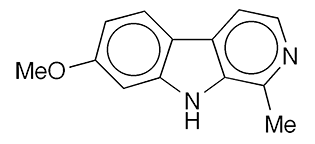
Harmine1 is one of several alkaloids that occur in the seeds of Peganum harmala, a flowering plant that grows in temperate climates such as the Mediterranean regions. Other major P. harmala alkaloids include harmaline2 and tetrahydroharmine3.
An early report on the P. harmala alkaloids came in 1911, when Ferdinand Flury at the University of Würzburg (Germany) described their pharmacology. Among other findings, he observed that harmine and harmaline paralyze frogs and cause convulsions in mammals.
Two years later, eminent organic chemist William Henry Perkin, Jr., and his graduate student Robert Robinson4 at the University of Manchester (UK) published a more detailed account of harmine and harmaline. They summarized previous work on the alkaloids, established a nomenclature system for alkaloids that have condensed pyridine and pyrrole nuclei, and prepared and characterized several alkaloid derivatives. Perkin and Robinson went on to publish six more articles on harmine and harmaline.
In the 1920s, articles began to appear about the occurrence of harmine, harmaline, and tetrahydroharmine in the South American vine Banisteriopsis caapi5. In one report, Lewis Lewin at the University of Berlin identified a substance he called banisterine in B. caapi and ascribed to it the same pharmacological effects as harmine. The two were later found to be identical. Lewin experimented with injecting the substance into humans and conjectured that it could be a therapeutic agent.
Lewin was on to something. B. caapi and an N,N-dimethyltryptamine6-containing plant, Psychotria viridis, are the components used to prepare ayahuasca, a psychedelic plant brew used for improved well-being by indigenous peoples in the Amazon rainforest. Recent studies have shown that ayahuasca and its components could have therapeutic value.
In 2023, Simon G. D. Ruffell at Onaya Science (Iquitos, Peru), the Psychae Institute (Melbourne, Australia), and the University of Melbourne and coauthors there and at other institutions worldwide extensively reviewed the historical, pharmacological, and therapeutic aspects of ayahuasca. The review included a table detailing the therapeutic and psychoactive effects of the P. harmala alkaloids; harmine was listed as having these properties:
- Antidepressant
- Enhancement of serotonin, norepinephrine, and dopamine levels
- Anti-addictive
- Diabetes management
The authors concluded, “Larger trials and longitudinal and multisite studies using advanced technology are necessary to evaluate ayahuasca’s potential as a medicine in western healthcare.”
A similar review was published the following year by Rafael Guimarães dos Santos* and Jaime Eduardo Cecilio Hallak at the University of São Paulo (Ribeirão Preto, Brazil) and the National Institute of Science and Technology in Translational Medicine (Porto Alegre, Brazil).







No comments yet. Be the first to comment!