
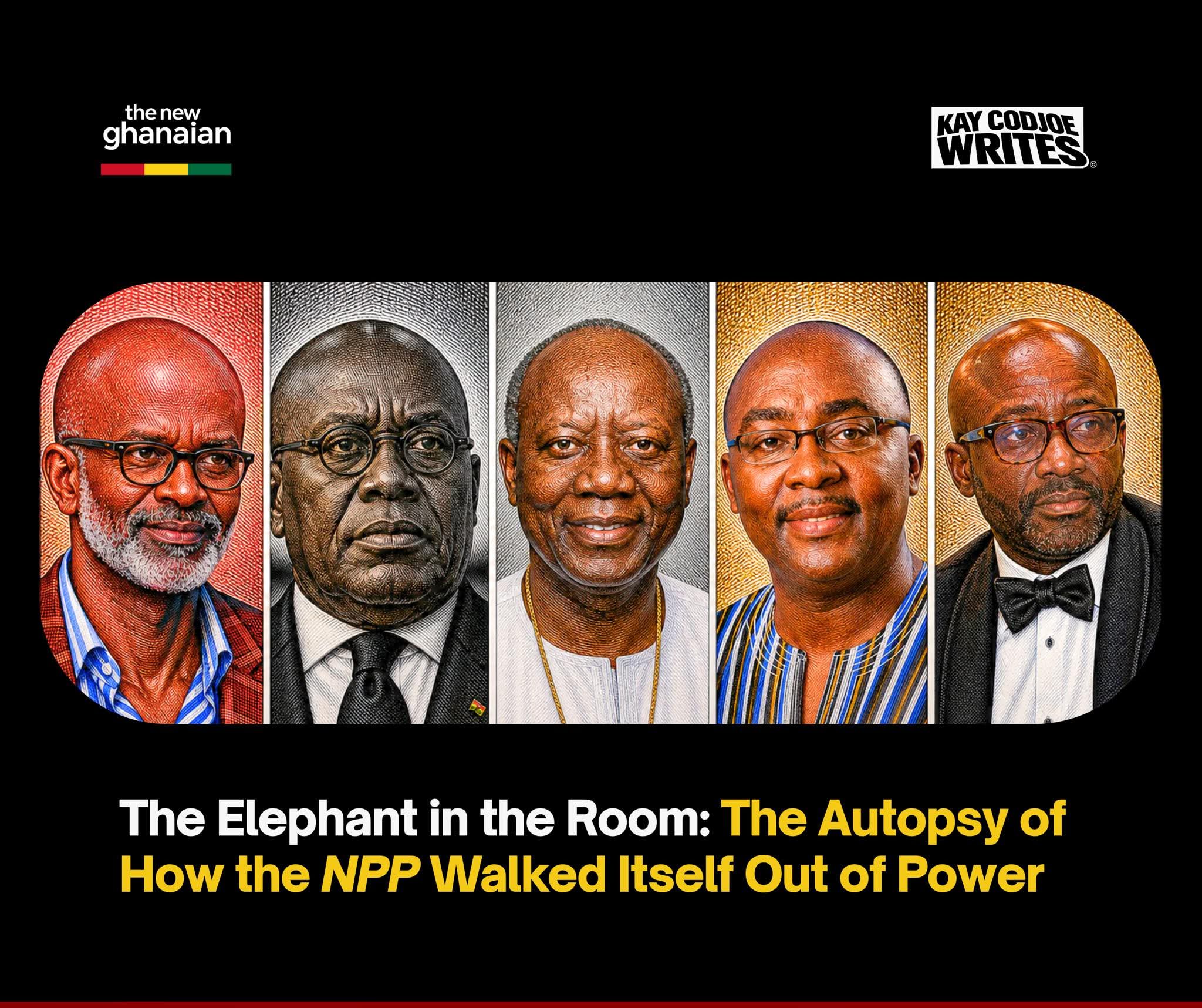
The New Patriotic Party did not lose the 2024 elections because Ghanaians suddenly fell in love with the National Democratic Congress. The NPP lost because it spent eight years manufacturing exhaustion, defending pain, normalizing arrogance, and mistaking propaganda for governance. By the time the ballots were counted, the election was no longer a contest. It was an eviction notice.
The tragedy for the NPP is not merely that it lost. Political parties lose elections everywhere. The tragedy is that the NPP lost while still believing it deserved to win. That delusion is now the party’s greatest opposition problem. The collapse did not begin in 2024. It began the moment the party stopped listening to ordinary people and started listening only to applause within its own echo chamber.
The 2020 elections already exposed deep cracks beneath the polished slogans. A governing party that once moved with confidence suddenly found itself struggling for parliamentary survival. The “economic management team” mythology was weakening. Citizens were growing impatient. The social contract was trembling.
Then reality arrived. Inflation exploded. The cedi became a public comedy. Fuel prices behaved like cryptocurrency. Businesses suffocated. Graduates wandered hopelessly. Pensioners watched investments evaporate under the Domestic Debt Exchange Programme (DDEP). Middle-class families that once defended government policies suddenly became victims of them. Yet throughout the suffering, portions of the political elite behaved like people watching a documentary about someone else’s hardship.
The communication became robotic. Whenever citizens screamed about pain, PowerPoint presentations appeared. Whenever businesses cried, the government announced digitalization. Whenever workers panicked, officials spoke in polished IMF vocabulary as if economic grammar could anesthetize hunger. Then came the arrogance. The dangerous kind.
The type that convinces leaders that criticism is hatred, suffering is exaggerated, and elections can be won through public relations gymnastics while citizens are drowning financially.
Even galamsey became symbolic of something bigger. Rivers turned brown while speeches remained clean. Forests disappeared while patriotism became theatrical. The state increasingly looked selective in outrage and inconsistent in enforcement.
People were not merely angry. They were emotionally exhausted. And then the NPP committed the greatest political error any ruling party can commit: it became disconnected from the emotional temperature of the country. That was fatal.
The transition from Akufo Addo to Bawumia only complicated matters further. Dr Bawumia faced an impossible burden. He wanted to campaign as change while standing inside continuity. He wanted distance from unpopular outcomes while remaining central to the administration that produced them.
The opposition understood the contradiction immediately. The NDC did not need a sophisticated campaign. It needed only one sentence: “You have suffered enough.” And that message landed like thunder.
The NPP entered the election speaking like accountants in a country that wanted grief acknowledged. Citizens were not searching for economic theories. They were searching for empathy, accountability, humility, and relief. Instead, many saw a party still defending itself rather than understanding the population. Then came election day. The defeat was brutal. Not because the NPP simply lost the presidency. Political power rotates. That is democracy. The humiliation was psychological.
A party that once behaved as though Ghanaian power naturally belonged to it suddenly found itself reduced to what many mockingly call a “demi-semi-minority". Eighty-seven seats. Not even one third of Parliament. And yet astonishingly, the NPP still appears not to understand what happened. That is the frightening part. Instead of deep introspection, the opposition often sounds like a confused aristocracy trying to understand why peasants revolted.
The blame game began immediately. Committees emerged. Camps formed. Factions sharpened knives. Everybody became an analyst except the people who governed. Some blamed communication. Others blamed candidates. Others blamed tribal arithmetic. Others blamed propaganda.
Very few confronted the central truth: Ghanaians did not vote against slogans. They voted against lived experience. Now in opposition, the NPP continues making dangerous mistakes. It still communicates with traces of superiority. It still underestimates public memory. It still behaves as though clever talking points can erase economic trauma. It still appears more interested in presidential succession than ideological reconstruction.
Most dangerously, portions of the party still speak like victims instead of authors of their own downfall. Opposition requires humility. The NPP still struggles with that word. But perhaps the more important question now is not whether the NPP has learned anything. The real question is whether the National Democratic Congress is learning anything while watching all this unfold.
Because political arrogance in Ghana has never belonged permanently to one party. It migrates. It evolves. Every ruling government eventually becomes tempted by the same disease: insulation from ordinary suffering, addiction to praise singers, hostility toward criticism, selective accountability, and the dangerous belief that electoral victory is equivalent to permanent public trust. That illusion destroyed the NPP. It can destroy the NDC too.
The voter has changed. The Ghanaian citizen is becoming less patient, less sentimental, less loyal, and more transactional. People are increasingly voting based on survival, not party inheritance. They are watching inflation more than ideology. Jobs more than jingles. Accountability more than applause.
If the NDC mistakes the NPP’s collapse as proof of its own invincibility, then it may unknowingly be rehearsing the same funeral procession in advance. Because the cemetery of Ghanaian politics is already full of parties that once thought they were untouchable.




No comments yet. Be the first to comment!