
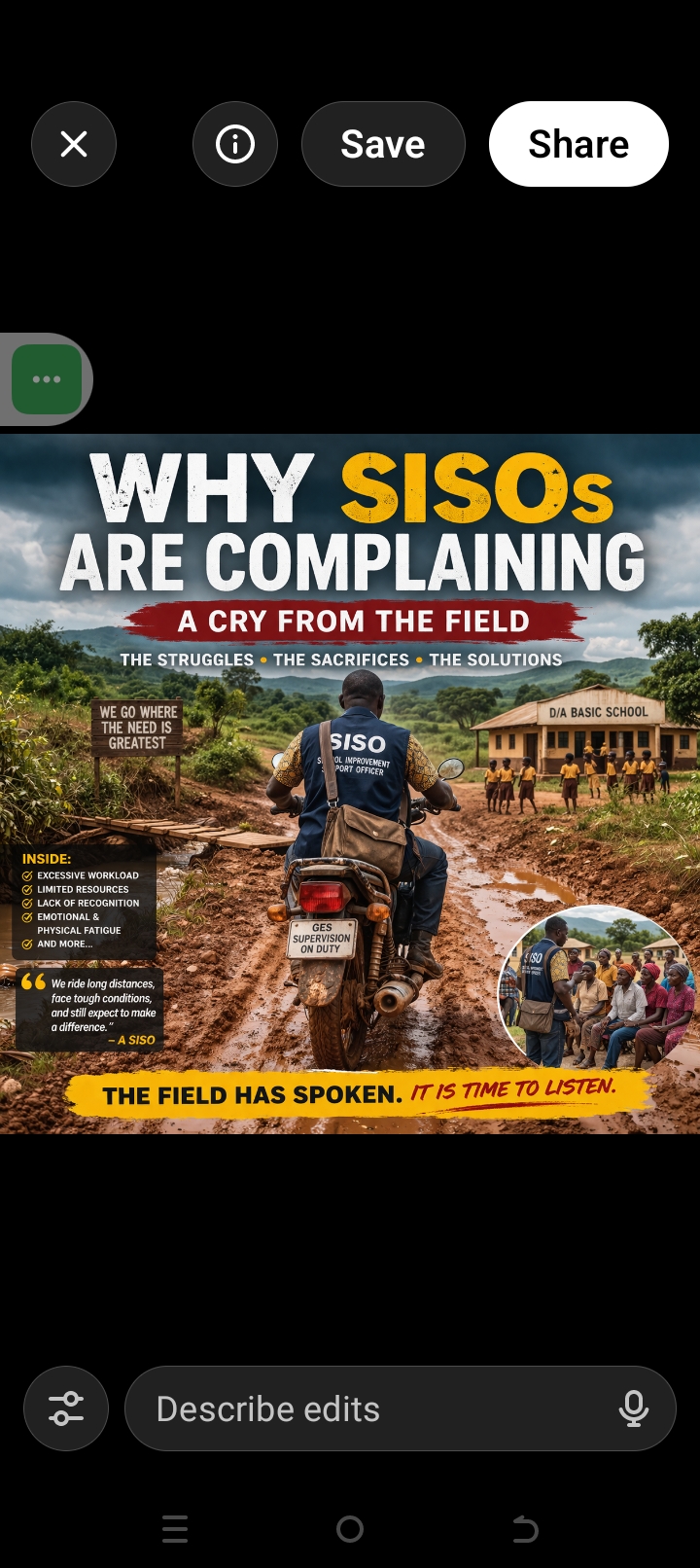
Introduction: Voices Rising from the Frontline
Across many districts, the School Improvement Support Officers (SISOs) have become the backbone of educational supervision. They are the bridge between the Directorate and the classroom, ensuring that teaching, learning, and administrative systems run effectively. Yet, beneath their commitment lies deep frustration. More and more SISOs are voicing their concerns—concerns that point to systemic issues that need urgent attention.
This article presents the realities on the ground and why SISOs everywhere are crying out for support.
1. Excessive Workload with Limited Resources
SISOs are charged with supervising dozens of schools across wide geographic areas. They trek long distances—often on poor roads—to monitor classrooms, hold conferences with teachers, and support heads.
Yet, many do so without motorbikes, fuel allocations, or logistical support. A job meant to be routine becomes a daily struggle for survival.
“How do you expect us to supervise effectively when we have no means of getting to the schools?” one SISO lamented during a field forum.
2. Administrative Burden Beyond Their Core Duties
The modern SISO is no longer just a supervisor. They are also:
Data collectors
Report writers
Facilitators of in-service training
Coordinators of extra classes
Monitors for NGO programmes
Organisers of district and regional directives
What should be supportive supervision has become a mountain of administrative tasks, assigned with tight deadlines and little support.
3. Lack of Professional Development and Motivation
Despite being the key technical officers on the field, many SISOs receive minimal refresher training. Workshops are infrequent, allowances are inconsistent, and opportunities for professional growth are limited.
When officers who train and assess teachers are themselves not empowered, motivation naturally drops.
A SISO once remarked:
“We motivate teachers, but who motivates us?”
4. Inadequate Recognition in the Educational Structure
While SISOs carry huge responsibilities, their role is often misunderstood or undervalued.
Some heads of schools treat SISO visits lightly. Some district leaders see them only as field messengers.
Yet, learning outcomes strongly depend on the quality of supervision—a fact often overlooked.
5. Pressure from Parents, Communities, and Leadership
SISOs feel the squeeze from all sides:
Parents blame them for poor results.
Communities expect miracles.
Leadership demands efficiency without providing tools.
Teachers see them as enforcers rather than partners.
Caught in the middle, they absorb pressure from every direction.
6. Salary and Promotion Concerns
Many SISOs entered the role with high hopes, believing it to be a channel for professional advancement.
However, promotions are slow, salary levels do not match the workload, and incentives for field officers are almost nonexistent.
7. Emotional and Physical Fatigue
When an officer spends long days on motorbikes, crosses streams to reach remote schools, prepares reports late into the night, and still receives criticism for delays, the emotional toll is heavy.
This fatigue is rarely recognised.
Conclusion: Time to Listen and Act
SISOs are not complaining because they are unwilling to work. They are complaining because they are working too much, with too little, for too long. Their cries are a call for systemic reforms—better logistics, clearer roles, improved motivation, and stronger institutional recognition.
If we truly want improved learning outcomes, then supporting SISOs is non-negotiable.
The field has spoken. It is time to listen.





IBRAHIM MAHAMADU
Apr 9, 2026 8:16 amThat's true, though am not a SISO,but I sometimes feel for them, particularly when is about the promotion and ranks. If s SISI visit a school where the Headteacher and some staff have higher ranks or equivalent, he might not be comfortable speaking with authority
adams inusah
Apr 9, 2026 1:28 pmThey work too much with nothing and they were like the class teacher before