
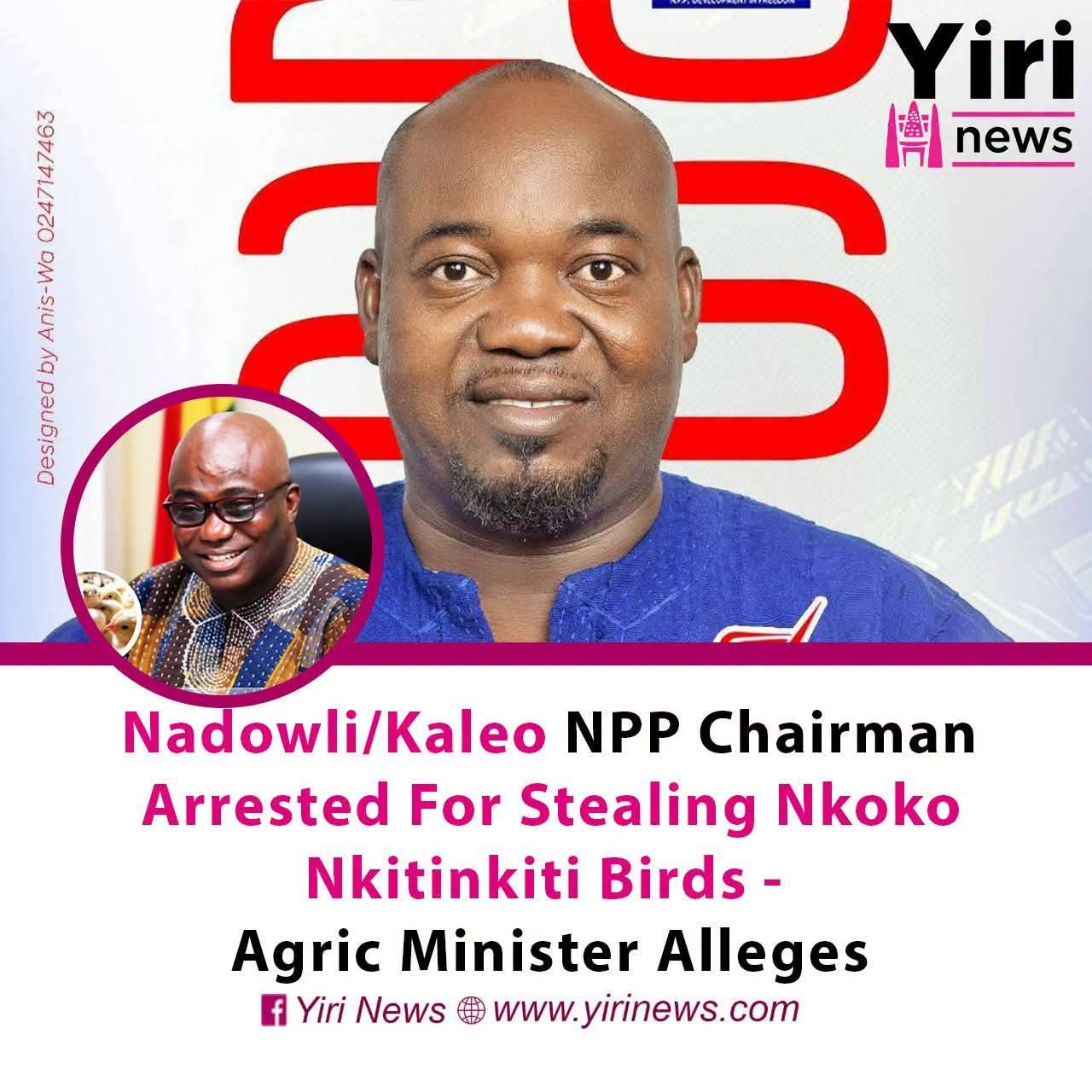
The reported conduct of the New Patriotic Party (NPP) Chairman in the Nadowli-Kaleo District, who allegedly stormed a government poultry brooding facility and made away with an unquantified number of chickens under the government's Akoko Nkitinkitin programme, is a matter of grave concern that deserves the immediate attention of law enforcement agencies.
If the allegations are established, this conduct goes beyond ordinary political misconduct. It raises serious questions about public order, respect for state institutions, the protection of government property and the rule of law. Indeed, the alleged seizure of the chickens bears the characteristics of robbery and unlawful appropriation of public property and must be investigated accordingly.
Information reaching The Trial News indicates that the NPP Chairman, accompanied by some party supporters, allegedly stormed the facility where chickens under the Akoko Nkitinkitin programme were being kept in the custody of the District Department of Agriculture. The group reportedly removed an unquantified number of the birds on the grounds that they, too, were Ghanaians and therefore deserved to benefit from the programme.
But this raises a fundamental question: since when did being a Ghanaian confer the right to forcefully take possession of government property?
The chickens were not being kept at the NDC constituency office for distribution to party members, neither were they abandoned public property available for anyone to claim. They were reportedly under the custody of the District Department of Agriculture, an institution operating under the Ministry of Food and Agriculture, for distribution to eligible and registered beneficiaries.
The programme was intended to support individuals who had expressed interest in poultry farming and were prepared to rear the birds as an economic activity. It was not an open invitation for anyone, regardless of their eligibility or preparedness, to invade a government facility and help themselves to whatever number of chickens they could carry away.
Even if one accepts the argument that the programme should benefit ordinary Ghanaians, that argument cannot justify forcefully taking government property. Public programmes operate under established procedures, eligibility requirements and administrative arrangements. Those who feel excluded have every right to petition the relevant authorities, demand transparency and seek redress. They have no right to resort to self-help, intimidation or unlawful seizure.
Did the NPP Chairman and the supporters who allegedly accompanied him register with the District Assembly or the Department of Agriculture as beneficiaries? Were their names included in the approved list of farmers? Do they have poultry farms or the necessary facilities to rear the birds? If they genuinely believed they had been unfairly excluded, why did they not follow the appropriate administrative channels?
These are legitimate questions that demand answers. What makes the alleged incident even more disturbing is the dangerous precedent it could establish if allowed to pass without accountability. Today, it is government poultry stock. Tomorrow, it could be agricultural inputs, fertilisers, food supplies, equipment or other public resources intended for vulnerable communities and deserving beneficiaries.
Can we afford to allow political party officials and their supporters to determine, through force and intimidation, who gets what from government programmes? Must public officials and state institutions surrender to political aggression whenever individuals decide that established procedures do not favour them?
Our democracy cannot survive on such a dangerous culture of impunity. Political affiliation does not confer immunity from the law, and no individual, regardless of their position within a political party, should consider themselves above the laws of Ghana.
The NPP Chairman's alleged conduct, if confirmed, is particularly disappointing because political leaders are expected to demonstrate restraint, responsibility and respect for public institutions. They should be at the forefront of promoting peaceful engagement and lawful conduct, not allegedly mobilising supporters to take possession of public resources through force.
The Ghana Police Service must, therefore, treat this matter with the seriousness it deserves. We call on the police to immediately investigate the incident, invite or arrest the NPP Chairman and all other persons reasonably suspected to have participated in the alleged seizure, recover the chickens and ensure that anyone found culpable is prosecuted in accordance with the law.
The District Department of Agriculture and the Ministry of Food and Agriculture must also provide a comprehensive account of what happened, establish the number of chickens allegedly taken, identify the beneficiaries affected and explain the measures being taken to protect the remaining birds.
This is not a matter of NDC versus NPP. It is a matter of protecting public property and upholding the rule of law. The chickens belong to a government programme funded with public resources, and their intended beneficiaries deserve protection from political interference and unlawful appropriation.
The people of Nadowli-Kaleo must not be made to believe that access to government resources depends on one's political strength, ability to intimidate public officials or willingness to break the law.
If the allegations are proven, the appropriate legal consequences must follow. Anything less would embolden others to believe that they can invade public institutions, seize government property and walk away simply because they have political connections.
The law must not be selective. It must not be intimidated by political colours, positions or affiliations. Let the police act, let the facts be established, and let justice take its course.
Nadowli-Kaleo deserves development, not political brigandage. Public resources must be protected, not seized by force.
The Trial News


No comments yet. Be the first to comment!