
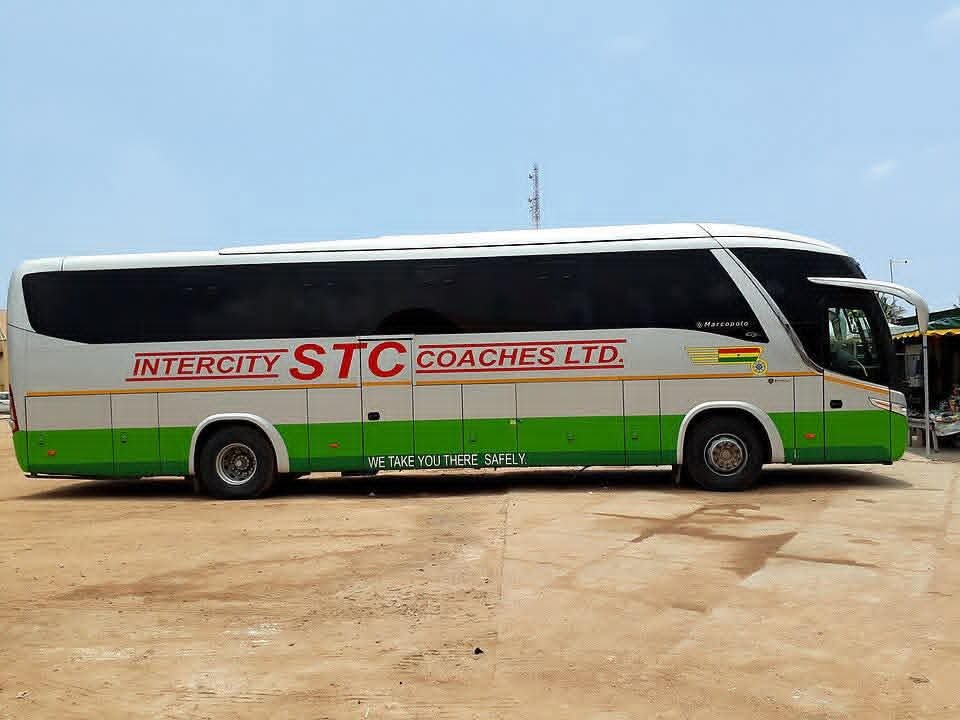
There was a time when travelling with the State Transport Corporation (STC) was not merely a means of getting from one destination to another; it was an experience passengers could trust. Alongside Metro Mass Transit, STC was one of the country's most dependable government-owned transport services, and many passengers deliberately chose it because of the comfort, safety and professionalism associated with its operations. Unfortunately, that confidence has steadily disappeared, particularly among passengers travelling between the northern part of the country and the southern parts.
I remember the days when STC buses were regarded as durable and roadworthy. Passengers could board a bus in Wa with reasonable confidence that it would get them to Accra or Kumasi without unnecessary disruptions. There was often a police officer on board to provide security, many of the buses had facilities such as Wi-Fi and toilets, the seats were comfortable, and the drivers and other staff appeared to understand that they were serving customers rather than merely transporting passengers.
The buses also operated in a manner that made long-distance travel more predictable. A bus leaving Wa for Accra, for example, would generally stop at designated locations such as Bamboi and Linda Dor, among other recognised points, rather than behaving like a commercial trotro that could stop almost anywhere because somebody wanted to board or alight. Passengers knew approximately what to expect, and that sense of order contributed to the reputation STC enjoyed.
Today, however, the story is painfully different. Passengers travelling from the northern parts of Ghana are increasingly confronted with buses that appear unfit for the long and difficult journeys they are expected to undertake. Old buses are frequently deployed on routes that require vehicles capable of enduring hundreds of kilometres on roads that are themselves in poor condition. Breakdowns have become so common that passengers can no longer be certain that the bus on which they begin their journey will be the same bus that takes them to their final destination.
In some cases, passengers are asked to wait at the station while a tyre is repaired or another mechanical problem is fixed before the journey can even begin. Imagine buying a ticket, arriving at the station expecting to embark on a long journey, and then discovering that the vehicle has to be repaired before it can leave. That is not merely inconvenient; it is psychologically exhausting, particularly for passengers who have appointments, connecting journeys or other responsibilities waiting for them at their destination.
My own most recent experience occurred around June this year when I travelled from Wa to Accra. At the station, I noticed that the bus we were expected to use had a 2010 registration. Naturally, I became concerned because of the distance we were expected to travel and the condition of some of the roads along the route. I therefore asked one of the workers why buses of that age were still being deployed for such long journeys when there was a high possibility of mechanical failure.
The worker looked at me for some time, sighed and then gave me an answer that was deeply discouraging. He explained that passengers in the north should consider themselves fortunate that private owners of some of the buses were willing to allow their vehicles to operate on northern routes. According to him, many bus owners were reluctant to send their buses to the north because of the condition of the roads.
That conversation revealed something even more troubling to me. I had always assumed that the buses carrying the STC name were predominantly vehicles owned by the State. I was therefore surprised to learn that a significant number of the vehicles being used may actually be hired from private owners and then branded for STC operations.
If that is indeed the situation, it raises serious questions about the government's commitment to providing safe and reliable public transportation for citizens, particularly those living in the northern parts of the country.
Why should the State have to depend so heavily on privately owned, ageing buses to transport citizens on some of the country's longest and most difficult routes? Why can't the government procure modern, durable buses specifically designed to withstand the conditions of Ghana's roads?
The answer cannot simply be that the roads are bad. If the roads are bad, that should be an even stronger reason for the government to invest in vehicles capable of operating safely on them. If a particular route is known to be difficult, the appropriate response should be to improve the road while simultaneously ensuring that public transport operators have vehicles suitable for the journey. The burden should not be transferred entirely to passengers.
Unfortunately, there appears to be a painful contradiction in how public officials and ordinary citizens experience Ghana's roads. Government officials travel in comfortable and often luxurious vehicles, while ordinary citizens are expected to endure old buses, broken-down vehicles, potholes, dust, heat and lengthy delays. Some officials can even avoid the roads altogether by travelling by air.
But how many ordinary residents of the northern parts of Ghana can afford a V8 vehicle or a domestic flight to Accra?
The people who depend on STC are not asking for luxury. They are asking for a safe, reliable and dignified means of transportation. A passenger who pays for a ticket from Wa to Accra should not have to wonder whether the vehicle will survive the journey. He or she should not have to prepare mentally for the possibility of changing buses two or three times because of mechanical problems.
The situation becomes even more disturbing when the operation of STC increasingly resembles that of a commercial trotro. A service that was once associated with structured long-distance transportation now appears, on some routes, to stop almost anywhere passengers want to board or alight. The result is that a journey that should take a reasonable number of hours can become an unnecessarily long ordeal.
A passenger travelling from Wa to Accra may find his or her bus stopping repeatedly to pick up passengers, dropping others off at places that are not part of the traditional designated stops, waiting for mechanical repairs and, in the worst cases, changing vehicles along the way. What should be a long journey becomes an endurance test. It is difficult to understand how a state transport company can operate in this manner without recognising the impact on passengers.
People travel for important reasons. Some are going for medical treatment. Others are attending funerals, weddings, examinations, job interviews, court proceedings, business meetings or other important engagements. A delay of several hours can therefore have consequences far beyond mere inconvenience.
Even more worrying is the safety dimension. A bus that is mechanically unreliable should not be placed on a long-distance route simply because there are not enough better vehicles available. Every mechanical breakdown on a long-distance journey exposes passengers to additional risks. When passengers are stranded on isolated stretches of road, particularly at night, their vulnerability increases considerably. This is why the government must stop treating public transportation as an issue that can be left to deteriorate quietly.
Since 1992, successive governments have made promises about establishing or developing railway connections between the southern and northern parts of Ghana. For decades, these promises have featured prominently in political campaigns, but many have failed to translate into a dependable railway system connecting the north to the south.
At various times, Ghanaians have heard promises of modern railway networks and even futuristic ideas such as space railways. Yet the fundamental problem remains: ordinary citizens still struggle to travel safely and comfortably by road between the north and south.
The people of northern Ghana deserve better. We deserve roads that are safe and motorable. We deserve public buses that are modern, mechanically sound and capable of completing the journeys for which they are deployed. We deserve transport services that respect passengers' time and dignity. Above all, we deserve to know that when we board a government-supported bus, the government has done everything reasonably possible to ensure that we arrive safely.
I am therefore appealing to the government, the Ministry responsible for transport and the management of STC to urgently review the company's operations on northern routes. The government must either fix the roads or provide buses that can safely withstand the existing road conditions. Ideally, it must do both.
The government should also provide the public with greater transparency about STC's fleet. How many buses does STC actually own? How many are hired from private operators? What is the average age of the buses operating on northern routes? How frequently are these buses inspected and serviced? What standards must privately owned buses meet before they are allowed to operate under the STC brand?
These are legitimate questions because passengers have a right to know whether the vehicles carrying them are fit for purpose.
The government must also restore discipline to the operation of long-distance STC services. A bus travelling from Wa to Accra should not operate like an ordinary trotro, stopping indiscriminately throughout the journey. There should be clearly defined stopping points, and those points should be communicated to passengers before departure. Where exceptions are necessary, they should be based on safety and operational considerations rather than convenience.
I also believe passengers have a role to play. If repeated complaints continue to fall on deaf ears, passengers travelling on these routes should consider peaceful and lawful forms of protest to demand better service. A peaceful demonstration at STC stations, organised responsibly and without destroying property or disrupting the rights of other citizens, could send a powerful message to the authorities that passengers have had enough.
Another option is for passengers to reconsider using STC where reasonable alternatives exist until meaningful improvements are made. A transport company cannot survive indefinitely if the people it is supposed to serve lose confidence in it. But this should not be interpreted as a call to destroy STC. On the contrary, it is a call to save and restore it.
Ghana needs a strong public transport system. Not every citizen can afford to own a car, pay for expensive private transport or board an aircraft. For many people in northern Ghana, buses remain one of the most affordable means of travelling to Kumasi, Accra and other parts of the country. STC therefore has an important public responsibility that goes beyond making profit.
The government must remember that the people sitting in those buses are citizens too. They are teachers, farmers, students, traders, nurses, civil servants, pensioners, artisans and businesspeople. They pay taxes and contribute to the development of the country. They deserve the same consideration for their safety and comfort that government officials expect when they travel.
The North cannot continue to be treated as though its citizens should simply endure whatever transportation conditions are provided to them.
We have endured deteriorating roads. We have endured unreliable buses. We have endured breakdowns, delays and unnecessary stops. We have endured journeys that stretch far beyond their reasonable duration. What we should not have to endure is the government's continued indifference to the situation.
The choice before the government is straightforward: fix the roads, replace the ageing buses, or do both.
What is unacceptable is to continue putting passengers at risk and then expect them to consider themselves lucky simply because an old bus has been made available to take them hundreds of kilometres.
STC once represented reliability, comfort and dignity in long-distance travel. It is time for the government to restore that reputation.
The people of northern Ghana are not asking for special treatment. We are asking for safe roads, reliable buses and the basic dignity every Ghanaian passenger deserves.
The Trial News



No comments yet. Be the first to comment!