
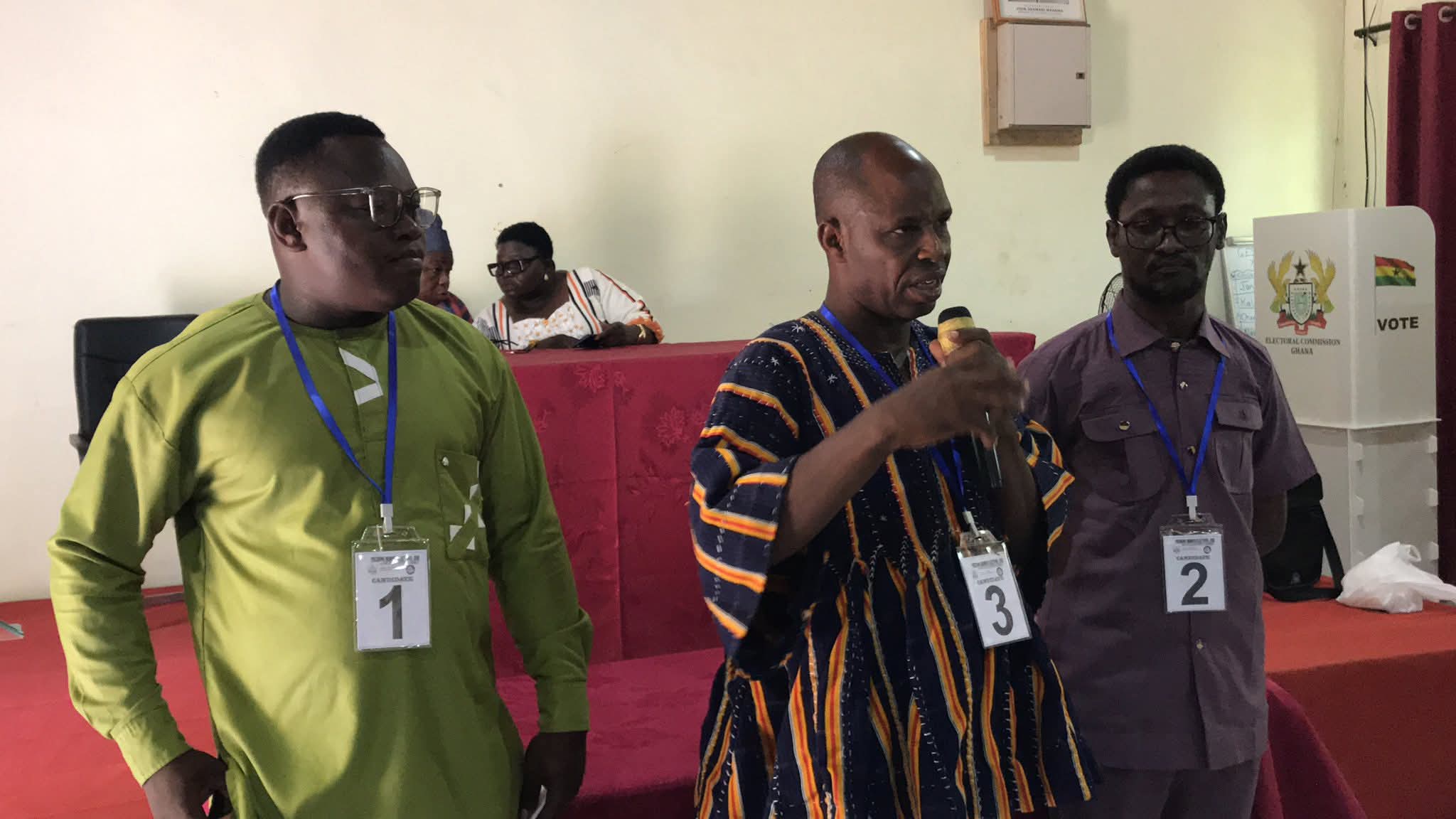
The continuing inability of the Nadowli-Kaleo District Assembly to elect a Presiding Member (PM) for the second time raises important legal, political and governance questions that deserve careful examination.
At the heart of the impasse is the constitutional requirement that a Presiding Member must be elected by at least a two-thirds majority of all members of the Assembly. This requirement is clearly provided for under Article 244(2) of the 1992 Constitution and reinforced by Section 17 of the Local Governance Act, 2016 (Act 936).
The law leaves little room for ambiguity. A Presiding Member cannot be elected by a simple majority. The threshold remains two-thirds of all Assembly members regardless of the number of voting rounds conducted.
It is against this legal background that reports of motions seeking to replace the two-thirds requirement with a simple majority must be examined. Although motions may be moved and seconded during Assembly proceedings, no motion can override the Constitution or an Act of Parliament. Consequently, any motion that purported to substitute the constitutionally required two-thirds majority with a simple majority is null and void and without legal effect. Such motions are inconsistent with the supreme law of the land and therefore cannot confer legitimacy on any election outcome.
The figures emerging from the Nadowli-Kaleo District Assembly make the situation even more intriguing.
The Assembly consists of a total of 53 members. This number includes elected members, government appointees and the District Chief Executive (DCE). Out of this number, the National Democratic Congress (NDC) is believed to command 45 members, comprising 28 elected Assembly Members, 16 government appointees and the DCE. The New Patriotic Party (NPP), on the other hand, is said to have only eight members.
On paper, these numbers should make the election of the Presiding Member relatively straightforward for the NDC. A two-thirds majority of 53 members is approximately 36 votes. With a numerical strength of 45 members, the NDC should theoretically be capable of electing a Presiding Member without relying on a single vote from the NPP. Yet the reality has been markedly different.
The first confirmation vote for the DCE reportedly produced only 23 votes in support of the nominee, falling significantly short of the constitutional requirement. As a result, the nominee failed to secure confirmation in the first round and had to await a second vote before eventually being confirmed. The first election of the Presiding Member produced a similarly disappointing outcome, with the leading candidate securing only 23 votes.
The obvious question is: Why? The inability of a political grouping with such overwhelming numerical superiority to secure the required constitutional threshold suggests that the challenge lies not with the opposition but within its own rank and file.
The recurring voting pattern points to internal divisions that appear deeper than many party faithful may be willing to admit. Whether these divisions stem from factional loyalties, unresolved grievances, personal rivalries or competing political interests remains a matter for political observers and party leadership to determine. Whatever the cause, the current political divisions are clearly unhealthy for the unity and progress of the party in the district.
What cannot be ignored, however, is the possibility that the long-discussed camp system within the NDC in the Nadowli-Kaleo District continues to exert considerable influence on local political dynamics.
If the Assembly's voting outcomes are any indication, numerical strength alone is proving insufficient to overcome internal fragmentation. The party's inability to translate its overwhelming majority into electoral success within the Assembly raises serious concerns about cohesion, discipline and collective commitment to a common developmental agenda.
The role of government appointees also deserves scrutiny. Government appointees are not ordinary Assembly Members. They are appointed to bring expertise, represent identifiable interests and support the effective functioning of local governance structures. Their appointment is ultimately derived from the authority of the government of the day.
While government appointees are not legally required to vote according to party instructions and must exercise independent judgment, it is reasonable to expect that they would generally support initiatives aimed at enabling the government to conduct its business effectively within the Assembly.
The persistent failure to elect key office holders therefore raises legitimate questions about whether all government appointees are advancing the broader objectives for which they were appointed.
If some appointees are consistently acting in ways that undermine the effective functioning of the Assembly and frustrate the implementation of government programmes, then the appointing authorities may need to reassess whether those appointments continue to serve the public interest.
This is not a call for blind loyalty. Rather, it is a call for accountability and clarity of purpose. Government appointees should be guided by the developmental needs of the district and the efficient operation of the Assembly.
The people of Nadowli-Kaleo deserve a fully functional Assembly capable of making decisions, approving policies and facilitating development. Political disagreements are inevitable in any democratic system, but prolonged paralysis serves neither the interests of government nor the welfare of the people.
The lesson from both the failed DCE confirmation and the ongoing Presiding Member election is clear: numbers alone do not guarantee victory. Unity, consensus-building and a shared commitment to development remain indispensable.
The NDC must therefore confront the difficult but necessary task of healing internal divisions and strengthening cohesion among its members. Its overwhelming majority in the Assembly should serve as a vehicle for development rather than a source of recurring deadlock.
The people of Nadowli-Kaleo are watching. More importantly, they are waiting for leadership, unity and results.
The Trial News

Servace KOMME Bansiibu
Jun 3, 2026 7:16 amThe views expressed in this article are thoughtfully balanced. Our honorable men and women should understand that no other interest is bigger than the collective interest of the assembly.
Simon peter
Jun 3, 2026 9:19 amA nice piece Senior brother It is worrying In my personal opinion it is the failure of the current NDC executives in the district/constituency Their failure started from the confirmation of the DCE up to date. Until all those involved realized the need to consensus building this problem will negatively affect the development of the district
Yendau Eugene
Jun 3, 2026 9:28 amThis indeed is a very serious development and therefore needs prompt attention by stakeholders. But my concern as a former Assembly member is, the DCE and the Member of Parliament are constitutionally mandated members of the governance structures of the Assembly, what exactly are they doing about this sad but shameful situation.? I don't want to bring in number 3 of Ghana for now even though he is capable of intervening as as SON for peaceful resolution all in the interest of the development of the entirety of the NADOWLI-DISTRICT