
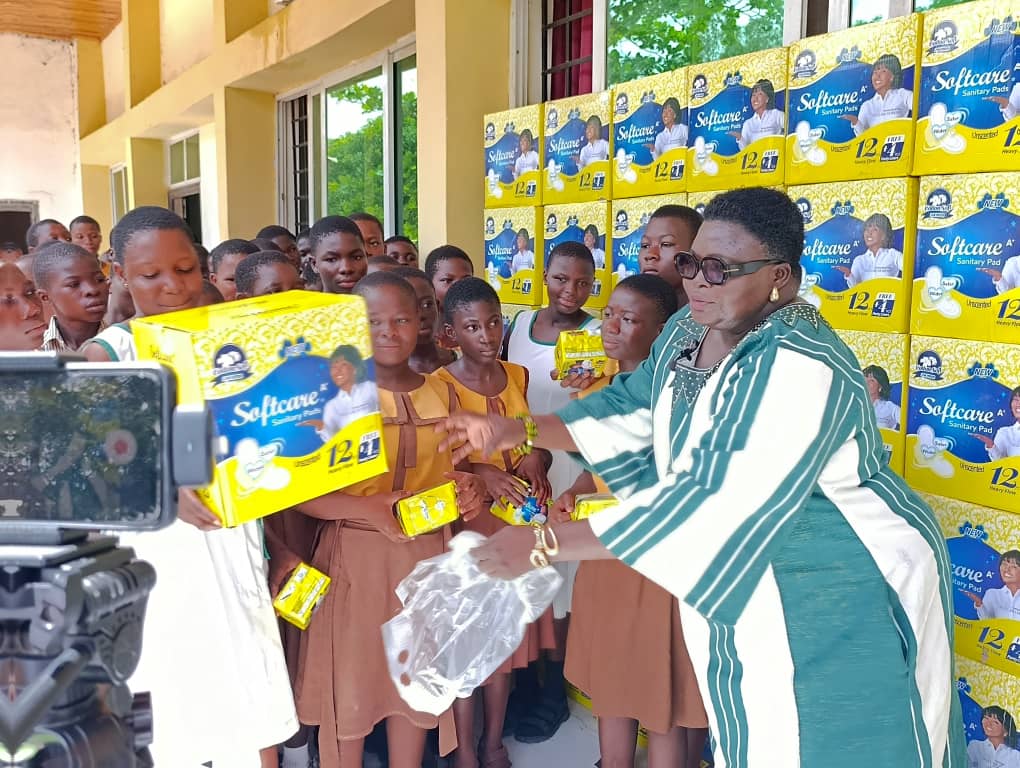
The District Chief Executive (DCE) for the Nadowli-Kaleo District in the Upper West Region, Madam Mary Haruna, has distributed sanitary pads to female students across the district as part of a nationwide initiative by the National Democratic Congress (NDC) government aimed at improving girl-child education and school retention.
The exercise forms part of the government’s policy intervention to support female students, particularly those from vulnerable backgrounds, to remain in school during their menstrual periods without interruption.
Speaking during the distribution exercise, Madam Mary Haruna explained that the cost of the sanitary pads was captured in the government’s recent budget, leading to the procurement and distribution of the items to female students across the country after the release of funds.
According to her, the Upper West Region received its share of the sanitary pads during the recent visit of the Vice President of the Republic of Ghana, Professor Jean Naana Jane Opoku-Agyemang, who joined the people of Sankana in the Nadowli-Kaleo District to celebrate the Kalibi Ganlaa Festival.
The DCE stressed the importance of the intervention, noting that many female students in deprived communities are often forced to miss classes during their menstrual periods due to their inability to afford sanitary pads.
She observed that some girls are compelled to stay away from school for days to engage in activities such as selling firewood and charcoal to raise money to purchase sanitary pads.
Madam Mary Haruna indicated that the initiative would help keep girls in the classroom alongside their colleagues, enabling them to focus on their studies and pursue their dreams without unnecessary challenges.
“The NDC government cares deeply about the education of female students because of their vulnerability in society,” she stated. “This gesture is intended to make them feel safe and comfortable during their menstrual cycle so they can continue learning without worrying about how to buy sanitary pads.”
She further noted that although some people may consider the initiative trivial, its impact on female education and welfare cannot be underestimated.
“As a woman and a former female student myself, I understand the difficulties many girls go through during their menstrual periods. I truly appreciate this initiative and commend the government for introducing it. It will go a long way to support parents who cannot afford these necessities for their daughters, while also helping the students themselves,” she added.
A health professional, Madam Latifa Ahmed, also used the occasion to educate the female students on the proper use of sanitary pads and the importance of maintaining good personal hygiene during menstruation.
She advised the students to keep themselves clean at all times during their menstrual cycles in order to avoid infections and other health complications.
Madam Latifa Ahmed further indicated that she deliberately wanted the male students to be part of the programme so they could better understand the menstrual process their female colleagues go through as a normal biological phenomenon.
According to her, educating boys on menstruation would help reduce stigma, embarrassment, and mockery often directed at girls during their menstrual periods.
She urged the boys to be supportive and understanding towards their female colleagues instead of ridiculing them whenever they accidentally notice menstrual stains on their uniforms.
“Rather than making fun of them, the boys should politely alert the girls and support them in such situations,” she advised.
Meanwhile, the Deputy Director of the Ghana Education Service (GES) in the district, Mr Adams Lampson, commended the government for what he described as a timely intervention to support female students. He said about 49 schools across the district have already received their share of the pads while the distribution is still ongoing.
According to him, many girls abandon school or absent themselves from classes simply because they cannot afford sanitary pads.
He expressed optimism that the initiative would help improve school attendance among female students and allow them to concentrate fully on their academic work.
Mr Lampson further encouraged the beneficiaries to take their education seriously and work hard to contribute meaningfully to the development of the Nadowli-Kaleo District and Ghana as a whole.
The distribution exercise was warmly received by students, teachers, and community members, many of whom described the intervention as a major step towards promoting girl-child education and improving menstrual hygiene management in schools.
The Trial News







No comments yet. Be the first to comment!