
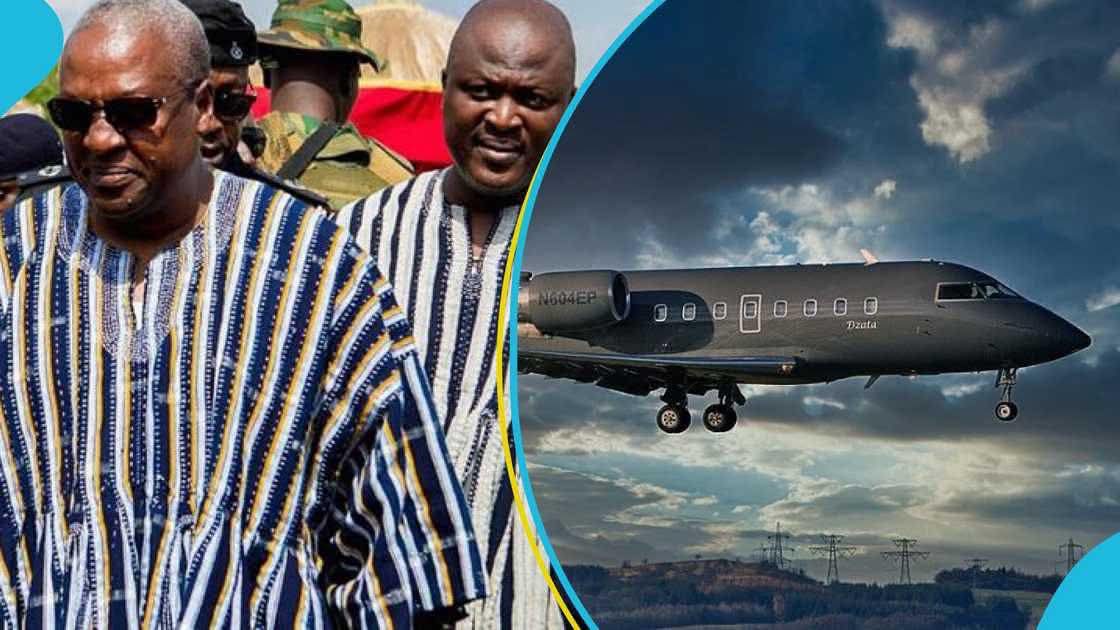
In every democracy, public accountability is not merely desirable—it is essential. When matters involving state resources and presidential privileges arise, citizens have a legitimate right to ask questions. The recent revelation that the President is using a private jet belonging to his brother for official travels has therefore raised important concerns that deserve transparent answers from the government.
At the centre of the issue is a simple question: why is the President not using the official presidential aircraft maintained by the Ghana Air Force?
Several possible explanations have been mentioned in public discussions, but none have been clearly confirmed by the government. Is it because the presidential aircraft is not in good operational condition? Is there a lack of trust in the Ghana Air Force’s ability to operate the aircraft safely? Or is the decision purely a financial one aimed at saving the state money?
These are legitimate questions that deserve straightforward responses.
If the presidential jet is currently not in a condition suitable for international travel, then citizens would naturally want to know why. Ghana maintains a presidential aircraft precisely to serve the needs of the Head of State. If the aircraft has technical issues, the logical question is whether the cost of fueling a private jet for multiple international trips could instead be used to repair or properly maintain the state aircraft.
Another dimension of the discussion touches on safety concerns. Some members of the public recall the tragic helicopter crash that plunged the nation into deep mourning and speculation at the time. In the aftermath of that incident, rumours circulated that the President himself might have been a target. Whether those rumours were credible or not, they contributed to a climate of anxiety.
Could security concerns be influencing the decision to rely on a private jet owned by a family member? If that is the case, it would be important for the government to clarify the reasoning so that citizens understand the security considerations involved.
Government officials have indicated that the state only pays for the fuel used by the private jet. On the surface, this may appear to be a cost-saving measure compared to chartering expensive aircraft. However, without clear figures and comparative data, it is difficult for the public to determine whether this arrangement is indeed the most economical option.
Ghanaians are particularly sensitive to this issue because of recent history. During the administration of former President Nana Akufo-Addo, there was widespread public criticism over the frequent chartering of expensive private jets for official travel. Many citizens questioned both the cost of those trips and the tangible benefits they brought to the country.
For a nation that continues to struggle with economic challenges and often depends on external financial support, government spending on presidential travel will always attract scrutiny. This is not necessarily an act of hostility toward leadership; rather, it is an expression of civic responsibility.
The current debate, therefore, should not be interpreted as mere criticism. It is a call for transparency.
If using the brother’s private jet is indeed the most cost-effective option for the state, then the government should present the facts clearly. A comparison of costs between repairing and operating the presidential aircraft, chartering jets, and fueling the private jet would help settle the matter and reassure the public.
However, if there are other reasons—whether technical, logistical, or security-related—the public also deserves to know. Silence or incomplete explanations only deepen suspicion and unnecessary speculation.
In a democratic society, trust between government and citizens is built through openness. When questions arise about the use of state resources, the best response is not dismissal but clarity.
Ghanaians are not asking for confrontation. They are asking for information. And on matters of national leadership and public funds, that is a reasonable request.
The Trial News
Alhassan
Mar 17, 2026 7:43 pmLet Ghanians discover the truth from your good work (THE DOWER OF THE ACTION)