
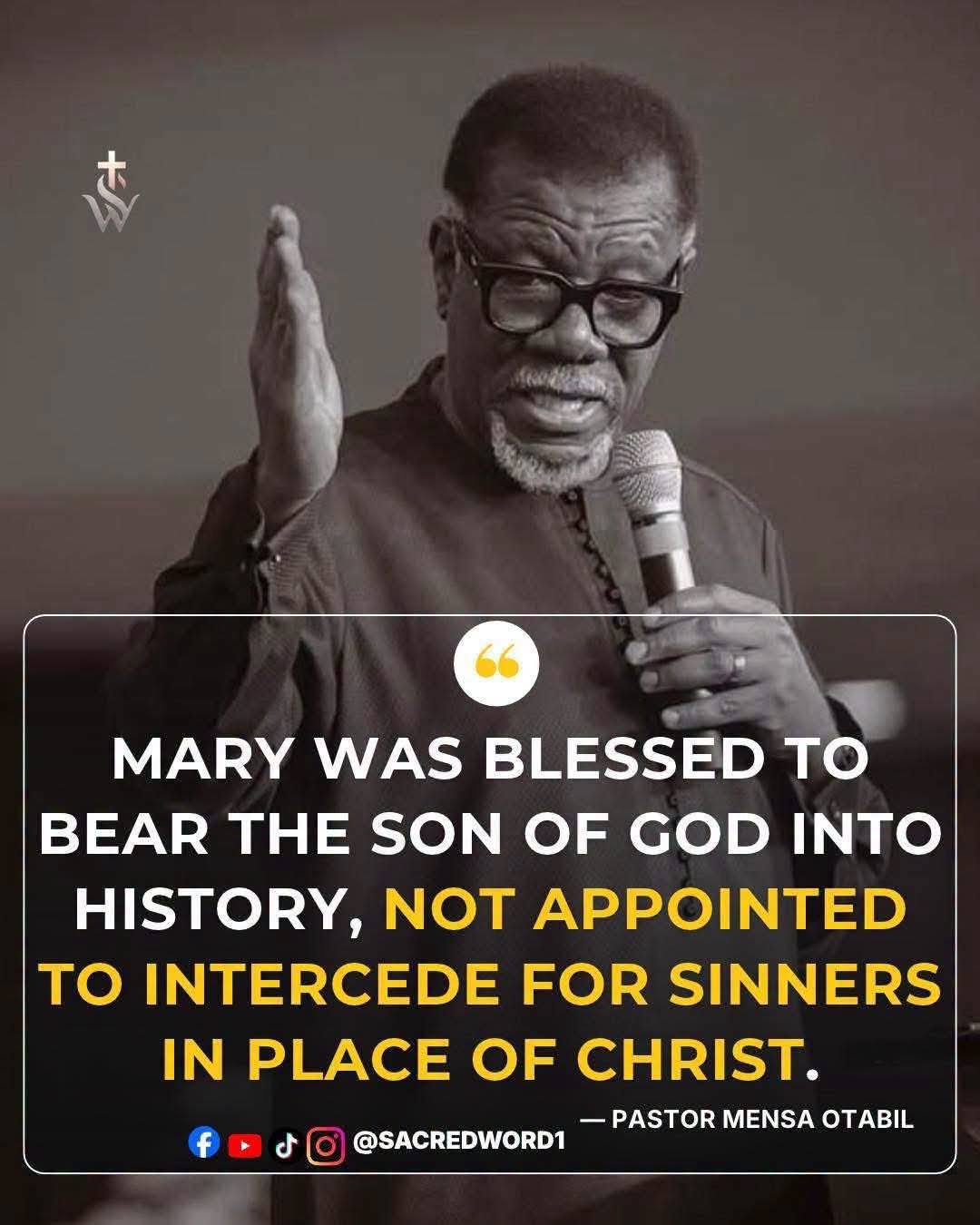
Religion is supposed to bring people closer to God and teach them how to live in peace, love and mutual respect. Unfortunately, some religious leaders appear to have mistaken the pulpit for a platform from which to ridicule the beliefs and practices of other denominations. This is not only unfortunate but also raises serious questions about the kind of Christianity they are promoting.
I was particularly disappointed after listening to Pastor Mensa Otabil's reaction to the Catholic practice of asking the Blessed Virgin Mary to pray and intercede for sinners. I found the approach deeply troubling, especially coming from a pastor of his standing and influence. A man of God with such a large following should know better than to turn a matter of religious difference into an occasion for mockery.
There is nothing wrong with a pastor explaining why his denomination interprets a particular biblical teaching differently. There is equally nothing wrong with engaging in theological discussions and respectfully challenging doctrines one does not agree with. However, there is a clear difference between explaining one's beliefs and ridiculing the beliefs of others. The pulpit should be a place for preaching the Gospel, strengthening faith and encouraging people to live according to the teachings of Christ. It should not become a stage for making other Christians feel inferior because they worship differently.
The Catholic Church's belief in the intercession of the Blessed Virgin Mary is not an attempt to replace Jesus Christ or elevate Mary above God. Catholics believe that Mary is the Mother of Jesus Christ, the woman chosen by God to bring the Saviour into the world. They honour her because of her unique role in salvation history and her extraordinary obedience to God's will.
More importantly, Catholics believe in the Communion of Saints. This teaching holds that those who belong to Christ remain united in Him, whether they are living on earth or have departed this world in God's grace. Consequently, Catholics ask Mary and other saints to pray for them, just as Christians ask fellow believers on earth to remember them in prayer.
There is a distinction between worship and veneration which critics of Catholicism often overlook. Catholics worship God alone. Mary is venerated, not worshipped. When Catholics ask her to intercede for them, they are asking her to pray to God on their behalf. They do not believe that she is God, nor do they regard her as an alternative saviour.
The biblical account of the wedding at Cana in John 2:1–11 is particularly significant to this belief. When the wine ran out, Mary brought the situation to the attention of Jesus. Her words to the servants, "Do whatever he tells you," remain a powerful expression of her role in directing people towards Christ. Catholics also draw inspiration from the words of Elizabeth in Luke 1:42 and Mary's own declaration in Luke 1:48 that all generations would call her blessed.
One may disagree with the Catholic interpretation of these passages. That is a matter of theological conviction. But disagreement does not justify ridicule. If a Christian pastor believes that Catholics are mistaken in asking Mary to intercede for them, he can explain his position using Scripture without making a mockery of their devotion. Respectful disagreement is possible without insulting the intelligence, sincerity or faith of those who hold a different position.
The bigger question is whether some pastors have become more interested in exposing what they consider the weaknesses of other people's beliefs than in preaching the message of salvation. Is the mission of a pastor to win souls for Christ or to win arguments against fellow Christians and people of other religions?
I find it equally strange to see Christian pastors engaging Muslim scholars in endless arguments about what they consider errors in the Bible or the Quran. Such discussions may provide opportunities for academic and theological exchange, but when they descend into insults, ridicule and an endless contest over whose holy book is superior, what exactly is being achieved? How many souls are being won through such confrontations? How many people are being inspired to become better human beings?
Christians and Muslims hold fundamental differences in their understanding of Jesus Christ. Christians believe that Jesus is the Son of God, that He died on the cross for the salvation of humanity and that He rose from the dead on the third day. Muslims, on the other hand, honour Jesus as a great prophet and the Messiah but do not accept His divinity in the Christian understanding. Islamic teaching also differs from Christianity on the crucifixion, while Muslims recognise Prophet Muhammad as God's final prophet. Christians, however, do not accept Muhammad's prophetic claims.
These are deeply rooted theological differences. They are not disagreements that can simply be settled by shouting louder, ridiculing one another or organising public contests to establish whose religious convictions are correct. A Christian cannot force a Muslim to accept the Christian understanding of Jesus, just as a Muslim cannot compel a Christian to abandon the belief in Christ's divinity and resurrection. Religious conviction cannot be imposed through humiliation.
This does not mean that Christians and Muslims should abandon discussions about their faith. On the contrary, meaningful interfaith dialogue is important. However, such engagement must be guided by mutual respect, intellectual honesty and a genuine willingness to understand one another. The objective should not be to humiliate the other person but to promote peaceful coexistence and deepen understanding.
The same principle applies within Christianity. Catholics, Pentecostals, Charismatics, Presbyterians, Methodists and other Christian denominations may interpret certain biblical teachings differently. Yet, they share a fundamental belief in Jesus Christ as Lord and Saviour. Why, then, should differences in religious practice become reasons for public ridicule and hostility?
What makes Christianity meaningful is not simply how loudly one argues about the Bible or how effectively one exposes what one considers the doctrinal shortcomings of another denomination. It is also how faithfully one lives out the teachings of Christ. Love, humility, forgiveness, compassion, patience and respect for one's neighbour are not optional virtues in Christianity. They are central to the faith.
Jesus Christ did not commission His disciples to spend their lives mocking people whose beliefs differed from theirs. He instructed them to preach the Gospel and make disciples of all nations. The Great Commission is about spreading the message of salvation, not turning religious differences into personal or denominational battles.
A pastor who spends more time attacking other churches than nurturing the spiritual lives of his own congregation should seriously reconsider his priorities. The same applies to religious leaders who make a habit of ridiculing Muslims or other religious communities. There is a difference between defending one's faith and disrespecting another person's faith.
Pastor Mensa Otabil, like every other Christian minister, has every right to explain his understanding of Scripture and defend the doctrines of his church. But influence comes with responsibility. Religious leaders must be conscious of the impact their words have on the people who listen to them. They should not use their platforms to create unnecessary divisions among people who ought to be learning how to live together in peace.
Ultimately, faith must be demonstrated through our conduct towards one another. A person may win a theological argument and still fail the basic test of Christian love. A pastor may quote several passages of Scripture and yet communicate a message that does little to promote humility, tolerance and compassion.
The Church needs more preaching that transforms lives, not more religious mockery. It needs ministers who can inspire people to love God, care for the vulnerable, forgive those who offend them and treat their neighbours with dignity. It needs religious leaders who understand that the purpose of the Gospel is not to make one denomination look superior to another but to bring people closer to God.
Men of God must return their attention to the central mission of their calling: winning souls for Christ and teaching people to live according to His example. They should preach with conviction, defend their doctrines with sound reasoning and disagree without contempt.
After all, the strength of one's faith should be evident not only in what one says about God but also in how one treats the people around them.




No comments yet. Be the first to comment!