
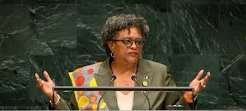
If there was one speech at this year’s United Nations General Assembly that refused to sound like another diplomatic recital of familiar grievances, it was the address delivered by Barbados’ Prime Minister, Mia Amor Mottley.
In a chamber filled with presidents, prime ministers and diplomats speaking about wars, climate change, inequality, artificial intelligence and a troubled international order, Mottley managed to do something remarkably difficult: she made the language of global politics sound human, urgent and memorable.
Her speech was not merely a catalogue of problems. It was a moral interrogation of the international system—and, more importantly, a challenge to the world to move from knowing what is wrong to actually doing something about it.
One of her most striking formulations was: “The failure… to address these challenges… is our repeated failure to convert what we know into what we do, to turn principle into practice and global capacity into solidarity.” Therein lies the heartbeat of her address.
The world, she argued, does not necessarily suffer from a shortage of knowledge. Humanity knows enough about climate change. It knows enough about war. It knows enough about inequality. It knows enough about artificial intelligence and the dangers of leaving transformative technologies without adequate global rules.
The crisis, therefore, is increasingly a crisis of responsibility, and Mottley did not spare the United Nations itself. She challenged the international community to go beyond cosmetic institutional reform. In one of the speech's sharpest passages, she declared: “Let us improve the machinery. But let us also reform the exercise of power.”
That sentence captures much of what made the speech so compelling. Mottley pointed directly at the architecture of global power, questioning why Africa — with 54 states — has no permanent seat on the Security Council, while five permanent members retain veto power. She also highlighted the exclusion of Small Island Developing States from assured representation despite the enormous challenges they face.
But perhaps the speech's most profound moments came when she connected the contemporary global order to history. Speaking about slavery, colonialism and reparatory justice, she argued that the mentality that once established and sustained slavery has echoes in contemporary inequalities within global institutions and the international financial system.
Then came a line that deserves to be remembered: “The mindset that established, justified and sustained slavery is the same mindset that sustains the iniquities and the inequities within the power structures of this very institution and within the international financial architecture.”
Whether one agrees with every proposition in that argument or not, its rhetorical force is undeniable. Mottley refuses to treat history as a museum exhibit. She connects historical structures to present-day questions of power, wealth and representation. And then, characteristically, she brought the argument back to humanity.
Quoting Barbados' Poet Laureate, she reminded the Assembly that the very name “United Nations” should represent a commitment to “ignite the fires of conscience, empathy, unity and equity.” Her closing words were equally evocative: “Let us together ensure the flames of hope, peace and dignity burn so bright that, in the midst of all the odds against us, they shine on all of the world.” That is what distinguished Mottley's intervention.
She spoke as the leader of a small Caribbean nation, but her vocabulary was global. She spoke about Africa, the Caribbean, Gaza, Sudan, Ukraine, Haiti, Cuba, Venezuela, climate change, AI, inequality, slavery and the future of multilateralism. Yet the speech never lost its central thread: human dignity and the responsibility of those who possess power to use it for the common good.
But it was when Mottley reached into Africa's history—and into the cultural memory created by Bob Marley — that her speech acquired an almost electric quality. She invoked Emperor Haile Selassie, who stood at the same United Nations rostrum in 1963 and spoke against racial supremacy and the unequal treatment of human beings. Those words were later immortalised by Bob Marley in his iconic song “War.”
Mottley told the Assembly: “Until the philosophy which holds one race superior and another inferior is finally and permanently discredited and abandoned, everywhere is war.” She continued with Selassie's warning about a world in which there are first-class and second-class citizens and where the colour of a person's skin determines the value attached to human life. It was a masterstroke.
Think about the symbolism: Haile Selassie spoke those words in the United Nations in 1963. Bob Marley transformed them into music in the 1970s. And Mia Mottley carried them back into the same global chamber in 2026. History had come full circle. The words had travelled from an African emperor, through the voice of a Jamaican reggae icon, and back to the world's premier diplomatic institution through a Caribbean prime minister.
That is the genius of Mottley's rhetoric. She understands that global politics does not have to be communicated exclusively in the dry language of communiqués, protocols, and diplomatic jargon. Sometimes the most powerful political truths already live in the songs, struggles, and memories of ordinary people, and Mottley knows how to summon them.
Mia Mottley did not simply take the podium at the United Nations. She took the microphone—and, for a memorable moment, made the world's most important diplomatic chamber sound like a place where somebody was actually talking to humanity.





No comments yet. Be the first to comment!