
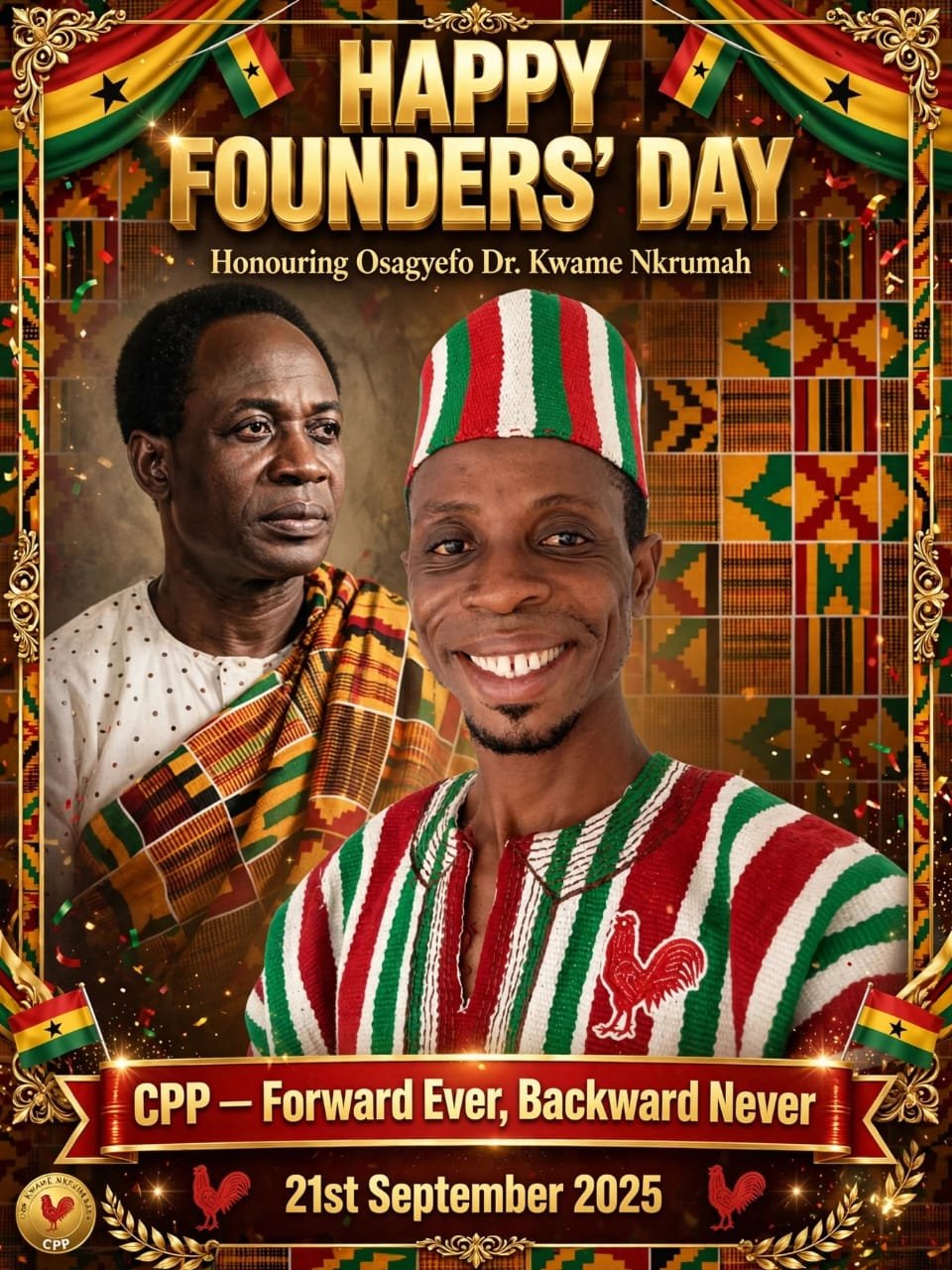
Because women contributed to Ghana's struggle for independence, and their contributions deserve recognition. However, there is no need to manufacture a needless argument over who should be regarded as Ghana's founder. History must recognise the person who ultimately led the political struggle to its decisive conclusion and, on Nkrumahism, stood before the nation and declared Ghana's independence. That person was Kwame Nkrumah.
Yet every September 21, I find myself asking a painful question: what exactly has the Convention People's Party done with the inheritance Nkrumah left behind? I ask this question not as an outsider but as someone who identifies with the CPP and the Nkrumahist tradition. That makes the question even more painful because, as a member of the party, I sometimes feel ashamed to write about an organisation that once represented one of the most powerful political movements in Africa but now appears to struggle with the most basic requirements of sustaining a serious political organisation.
We have become exceptionally good at celebrating Nkrumah while becoming increasingly poor at building the political organisation capable of carrying his ideas into the future. Every year, we gather, make speeches, display his photographs, quote his famous words and praise his achievements. We celebrate his birthday, remember his contribution to independence and remind ourselves of the great vision he had for Ghana and Africa. But when the celebrations are over, the CPP returns to the same internal disputes, organisational weaknesses and financial difficulties that have prevented it from becoming the political force that many Nkrumahists claim they want it to be. What, therefore, does Ghana gain from constantly celebrating the birth of Nkrumah if those who claim to inherit his political legacy cannot even demonstrate the unity, discipline and self-reliance that characterised the very political party he built?
Nkrumah did not establish the CPP merely to create an organisation that would commemorate his birthday every September. He built a mass political movement capable of mobilising ordinary people, organising communities and translating political ideas into national programmes. The CPP therefore cannot continue to live on Nkrumah's historical reputation while failing to demonstrate the organisational strength necessary to keep his political tradition alive. If the party genuinely believes that Nkrumah's ideas remain relevant to Ghana, then it must prove that relevance through its organisation, policies, finances and conduct.
One of the most troubling aspects of the CPP's current situation is its apparent dependence on financial assistance from political forces that are themselves competitors within Ghana's political space. It is difficult to understand how a political party that claims to offer an alternative to the established political order can continuously depend on the very political forces it seeks to challenge. In ordinary political warfare, it would be absurd for one general to provide military resources to another general while preparing to fight him. The same principle should make political parties cautious about becoming financially dependent on their opponents. Cooperation and dialogue between political parties are normal features of democratic politics, but financial dependence on a political competitor creates legitimate questions about independence, accountability and the interests being served.
The CPP must therefore answer some uncomfortable questions. Where are the dues-paying members? Where are the functioning party structures? Where are the sustainable sources of party revenue? How does a party that has participated in national elections for so many years continue to struggle with the resources required to maintain its own offices and activities? These questions are not being asked because the CPP should be denied its constitutional right to participate in Ghana's democratic process. They are being asked because a political organisation that intends to govern a country must first demonstrate that it can govern and sustain itself as an organisation.
This also brings the Electoral Commission into the conversation. The EC has an important responsibility in regulating political parties and administering Ghana's electoral system. If the law requires political parties to maintain particular organisational structures and offices, then Ghanaians are entitled to ask whether such intervention requirements have been applied to parties that continue to participate in general elections despite apparent organisational weaknesses. If questions exist about whether a political party has satisfied the requirements imposed by law, the appropriate institutions should provide clear answers. The issue should not be treated as an attack on the CPP but as a matter of electoral accountability and equal application of the law.
The CPP itself should welcome such scrutiny because a serious political organisation should not fear questions about its finances, membership, offices, structures or sources of support. It should be able to open its books, explain its organisational arrangements and demonstrate that its survival does not depend on the generosity of competing political organisations. If the party cannot do this, then its members must have the courage to confront the problem rather than pretending that everything is well.
The problem, however, goes much deeper than money. The fragmentation of the Nkrumahist tradition has deprived Ghanaian voters of a coherent political alternative. Several parties and political organisations have claimed some connection with Nkrumahism over the years, yet the fragmentation of that tradition has made it difficult for the electorate to see one united political force presenting a consistent national programme. Instead of asking the Ghanaian voter to take Nkrumahism seriously, the Nkrumahist political tradition must first demonstrate that it can take itself seriously. That begins with unity, discipline and a willingness to place the interest of the political tradition above individual ambitions.
There is also a dangerous tendency within smaller political parties to interpret every internal disagreement as evidence of external interference. Claims that rival political parties deliberately plant people within other organisations should not simply be accepted as facts without evidence. However, the possibility of external influence is precisely why political parties must build strong internal institutions, transparent financial systems and accountable membership structures. A politically healthy party cannot be controlled by personalities, financiers or factions; it must be governed by its constitution, its members and clearly established democratic institutions.
This is where the CPP must begin a serious process of internal reconstruction. Members must be prepared to pay their dues, branches must function, constituency structures must meet regularly, party accounts must be transparent, fundraising must become sustainable and political education must be strengthened. The party needs young people who understand Nkrumah beyond photographs, slogans and quotations. Above all, it needs leaders who understand that the CPP is not a private business opportunity but a political organisation whose historical significance imposes a responsibility on anyone who chooses to lead it.
If people enter the CPP merely to obtain personal material benefits, then they are not preserving Nkrumah's legacy; they are consuming it. The party must therefore return to the language of sacrifice that characterised the independence movement. Political leadership cannot be reduced to the struggle for positions, access to resources or personal advancement. Anyone who claims to be a Nkrumahist must be prepared to ask what he or she is contributing to the survival and development of the political movement rather than what can be taken from it.
The CPP also needs to move beyond the politics of commemoration and begin discussing how Nkrumah's ideas can be translated into contemporary policy. Nkrumah's government pursued industrialisation, infrastructure development, state-led economic transformation and human-capital development. His administration also faced serious economic difficulties and policy challenges, and there is nothing wrong with examining those shortcomings honestly. In fact, genuine Nkrumahism should have no fear of historical scrutiny. But whatever one's assessment of individual Nkrumah-era policies, one lesson remains important: Nkrumah believed that Ghana could not build a meaningful future by permanently depending on others to determine its economic destiny.
That is precisely the lesson today's CPP needs to recover. A party that claims to represent Nkrumah cannot continue to behave as though its political survival depends on the goodwill of larger political parties. Political independence requires organisational and financial independence. If the CPP wants Ghanaians to believe that it can provide an alternative to the NDC and NPP, then it must first demonstrate that it can stand independently of both parties.
The history of Nkrumah's overthrow must also be discussed honestly. On February 24, 1966, Nkrumah's government was overthrown by the military and police; the CPP and National Assembly were dissolved, and the Constitution was suspended. The coup leaders cited economic deterioration, corruption, repression and alleged abuses of power as reasons for the takeover. Whatever criticisms may have been made against Nkrumah's government, however, the overthrow of a constitutional government by a military intervention opened another chapter of political instability in Ghana. The country subsequently experienced alternating civilian and military governments, including further coups, before eventually returning to constitutional democratic rule.
The question that must therefore be asked is simple: after the overthrow of Nkrumah, did Ghana suddenly become a developed country? Did the coup solve all the problems that its architects claimed they were coming to solve? History does not support such a simplistic conclusion. Ghana continued to experience economic difficulties, political instability and military interventions after 1966. At the same time, it would also be historically irresponsible to pretend that Nkrumah's government had no shortcomings. The proper lesson is that Ghana's development cannot be reduced to the glorification of one individual or the demonisation of another. What Ghana needs is strong institutions, democratic accountability, continuity and leaders capable of putting the national interest above personal and factional interests.
Those who overthrew Nkrumah and convinced many Ghanaians that Nkrumah and the CPP were the fundamental problem facing the country must therefore also be judged by the consequences of the political order that followed. The coup did not magically remove Ghana's developmental problems. Instead, Ghana entered decades of political uncertainty, with successive governments struggling with many of the same economic and institutional challenges. The lesson for today's CPP is not simply to condemn the coup and stop there. It is to understand why a political movement that once commanded such enormous popular support was allowed to become vulnerable and why its political descendants have failed to restore that confidence.
It is therefore not enough for today's CPP to condemn those who overthrew Nkrumah more than six decades ago while allowing the political organisation he built to weaken from within. It is not enough to accuse others of betraying Nkrumah while party members themselves fight over positions and resources. It is not enough to accuse the NDC and NPP of contributing to Ghana's economic problems while failing to build a credible organisation capable of presenting the electorate with a coherent alternative. And it is certainly not enough to celebrate Nkrumah's birthday every September 21 while doing little to translate his political philosophy into practical programmes for contemporary Ghana.
Nkrumah must become more than a monument. He must become a political responsibility. If the CPP genuinely believes that his ideas remain relevant, then the party must demonstrate that relevance through organisation, economic self-reliance, internal democracy, political education, discipline, transparency and a serious national development programme. The party must stop behaving as though Nkrumah's historical reputation alone can win elections. It cannot. Ghanaian voters have the right to demand evidence of seriousness from every political party, and the CPP is no exception.
The Ghanaian voter already knows the two major political parties and has experienced their governments over the years. Many citizens have expressed dissatisfaction with the country's economic and political direction, but dissatisfaction with the NDC and NPP does not automatically translate into confidence in the CPP or any of the fragmented parties claiming the Nkrumahist tradition. The responsibility for changing that situation lies primarily with the smaller parties themselves. They must convince Ghanaians that they are capable of governing rather than merely asking voters to reject the established parties.
The CPP therefore has to stop asking Ghanaians to vote for Nkrumah's memory and start giving them reasons to believe in the future of Nkrumah's political tradition. That future cannot be built through factionalism, dependency, personal enrichment or endless leadership crises. It cannot be built by constantly blaming external forces for every internal problem. It can only be built through serious organisation, responsible leadership, united membership and a clear programme capable of addressing the problems confronting Ghana today.
On this 117th anniversary of Kwame Nkrumah's birth, perhaps the greatest tribute the CPP can offer him is not another speech, another wreath or another collection of photographs. The greatest tribute would be to rebuild the party he founded, unite its members, establish functioning structures, become financially independent, educate its supporters, develop credible policies and account transparently to the people who continue to associate the CPP with Nkrumah's name.
The real question facing Nkrumahists today is not whether Nkrumah deserves to be celebrated. He does. The real question is whether those who claim to be his political heirs are prepared to do the difficult work required to make his vision relevant to another generation. Until that question is answered, every celebration of Nkrumah's birthday should also be a moment of uncomfortable self-examination for the CPP.
Happy 117th birthday to Osagyefo Dr Kwame Nkrumah. But beyond the celebrations, let the work begin. Nkrumah Never Dies!
Long Live Nkrumahism
Long Live CPP
Long Live Ghana
A CONCERNED MEMBER OF THE CPP
NADOWLI-KALEO CONSTITUENCY
UPPER WEST REGION

No comments yet. Be the first to comment!