
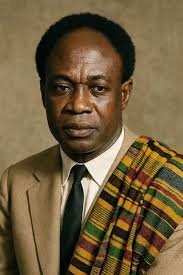
The torchlight of common sense was symbolically lit 117 years ago today with the birth of one of Africa’s most consequential sons, Osagyefo Dr Kwame Nkrumah, on 21 September 1909, in what was then the Gold Coast and is today the Republic of Ghana.
His birth marked the arrival of another African child into the world. In the fullness of history, it was the beginning of a political and intellectual journey that would eventually challenge colonialism, inspire liberation movements across Africa, and place Ghana at the centre of the struggle for African emancipation.
Nkrumah famously declared: “I am an African, not because I was born in Africa, but because Africa was born in me.” That declaration captures something larger than geography. It speaks to an identity rooted in consciousness, history, dignity, and a determination to see Africa rise above the structures that have historically kept her politically dependent, economically vulnerable, and intellectually subordinate.
Today, 117 years after his birth, the question is not merely whether Nkrumah should be remembered. The more important question is whether Africa has sufficiently understood the ideas for which he lived.
Nkrumah Never Dies
Nkrumah may have died physically, but Nkrumahism has proved remarkably difficult to bury. His overthrow in the 1966 coup represented, in the eyes of his admirers, not merely the removal of a president but a rupture in an unfinished African project. The circumstances surrounding his overthrow and the subsequent trajectory of Ghanaian and African politics remain subjects of historical debate.
Yet one fact is difficult to dispute: the questions Nkrumah raised about African sovereignty, economic independence, continental unity and neocolonialism did not disappear with his removal from office. Indeed, they have returned repeatedly in Africa's political discourse.
Nkrumah understood that political independence without economic independence could become a fragile achievement. A flag could be changed, a national anthem introduced, and a colonial administration replaced by African officials, yet the deeper structures of dependency could survive after his death.
That is why his conception of independence went beyond the lowering of one flag and the raising of another. For Nkrumah, independence had to mean the capacity of Africans to determine their own destiny. And that journey is far from complete. That explains why, in his declaration on 6th March, 1957, Ghana's Independence Day, emphasizing that Ghana's independence was only part of a larger Pan-African liberation struggle, as quoted: “Our independence is meaningless unless it is linked up with the total liberation of the African continent.”
Independence Beyond the Flag
What does it mean for a country to be politically independent while remaining heavily dependent on external powers for capital, technology, manufactured goods, expertise and even intellectual frameworks? This is one of the uncomfortable questions Nkrumah's legacy continues to force upon us.
Africa possesses enormous natural resources, an enormous youthful population and considerable intellectual capacity. Yet many African economies remain structurally dependent on exporting raw materials while importing finished products made from those same resources.
We export cocoa and import chocolate. We export minerals and import sophisticated manufactured goods. We possess enormous agricultural potential while importing significant quantities of food. And, perhaps most importantly, we sometimes import ideas about ourselves before taking the trouble to rediscover the intellectual resources within our own history.
The problem, therefore, is not simply what the former colonial powers do or have done. It is also what Africans have permitted, embraced or failed to challenge. Our insatiable appetite for foreign products, our dependence on external validation and our willingness to measure African achievement principally through foreign standards are part of the broader psychological dimension of the independence question.
Just imagine the recent IMF report bastardising GOLDBOD and being given prominence by surrogates of the regime who perpetuated the overthrow of Nkrumah. Nkrumah's challenge was ultimately a challenge to the African mind. You can see that the IMF is in a lucrative business and wouldn’t budge, while the named surrogates are simply non-Nkrumahist — characteristic of greed, hypocrisy, and self-centredness.
The Battle for the African Mind
Political liberation is incomplete if mental liberation does not accompany it. This is where education becomes indispensable. Nkrumah's life and intellectual contributions should not be confined to occasional speeches at commemorative ceremonies or the pages of history textbooks. His ideas should be studied seriously, interrogated critically, and placed within the broader intellectual history of Africa.
African children should learn not only that Nkrumah became Ghana's first Prime Minister and first President, but also why he believed African unity was indispensable, why he warned about neocolonialism, why he advocated industrialisation, and why he believed Africa's resources had to serve African development.
We should teach Nkrumah not as an untouchable political idol but as an intellectual whose ideas deserve rigorous examination. His successes, mistakes, achievements, controversies, and failures should all be studied. That is how an intellectual legacy becomes an institution rather than a monument.
From Nkrumah to the African Question Today
Commemorating Nkrumah's 117th birthday in 2026 is particularly significant. Earlier this year, Ghana spearheaded a historic United Nations resolution declaring the trafficking of enslaved Africans and racialised chattel enslavement of Africans “the gravest crime against humanity.” The UN General Assembly adopted the resolution on 25th March, 2026, with 123 votes in favour, while 3 countries voted against and 52 abstained.
President John Dramani Mahama presented Ghana's case within the wider African campaign for reparatory justice, arguing that historical truth, dignity and justice for Africans and people of African descent must remain part of the international conversation.
Whatever one's political affiliation, the significance of the development is unmistakable: Ghana placed an explicitly African historical grievance at the centre of a major multilateral debate. For admirers of Nkrumah, that naturally evokes his insistence that the dignity of Ghana could not be separated from the dignity of Africa.
It also demonstrates that the struggle for African emancipation has changed its battlefield. The colonial flag may have disappeared from many African capitals, but questions of historical justice, economic sovereignty, ownership of resources, global financial structures and Africa's representation in international institutions remain very much alive.
The United Nations itself has acknowledged that the legacies of slavery continue to shape social and economic inequalities and has called for truth, justice and reparative action. Thanks to his Excellency, the president of Ghana, Dr John Dramani Mahama.
The Nkrumahist Echo Across Africa
For many Pan-Africanists, Nkrumah's ideas continue to find echoes in contemporary African political thought. In my own assessment, I have seen elements that remind me of Nkrumah's broader ideological project in the leadership and political philosophies associated with figures such as John Dramani Mahama, Paul Kagame, Duma Boko, Ibrahim Traoré, Julius Malema, and the late Muammar Gaddafi, although these leaders belong to very different political traditions and historical circumstances.
The comparison should therefore not be understood as suggesting that they are identical to Nkrumah or that their records are beyond criticism. Rather, it reflects the continuing relevance of questions Nkrumah placed before Africa: Who controls Africa's resources? Who determines Africa's destiny? How can African countries move beyond dependency? And how can Africans reclaim the dignity of a people whose history has too often been written by others?
Gaddafi, in particular, represented an unusually forceful contemporary expression of African continentalism and resistance to Western dominance, whatever disagreements may exist about his methods, record, and legacy. The larger point is that Nkrumah's questions have outlived the man who asked them.
A Saint, a Symbol—or an Institution?
To many Africans, Nkrumah has acquired something approaching a sacred place in the political imagination. Some regard him as the father of modern Ghana. Others see him as the intellectual father of modern Pan-Africanism. Admirers have called him the man of the millennium. For some, he is almost a political saint, but perhaps the greater tribute would be neither canonisation nor worship. It would be institutionalisation.
Nkrumah's life should become an institution of learning. His writings should be systematically studied in African schools and universities. His speeches should be preserved, digitised and made accessible. His economic ideas should be debated by economists. His foreign policy should be examined by political scientists. His Pan-African philosophy should be scrutinised by historians. His understanding of neocolonialism should be tested against contemporary African economic realities.
The objective should not be to manufacture another generation of unquestioning Nkrumah loyalists. It should be to produce Africans capable of thinking as deeply about Africa as Nkrumah did. That would be a far more enduring monument.
The Family, the Memory, and the Man
It was particularly heartwarming to see members of Nkrumah's family come together to commemorate the 117th anniversary of his birth. Behind the political icon was a father, grandfather, husband, and human being. Behind the statues and books was a man who dreamed of an Africa that would stand on her own feet. Behind the revolutionary rhetoric was a Ghanaian who believed that the liberation of Ghana had meaning only within the broader liberation of Africa.
That is the Nkrumah worth remembering and not merely the Nkrumah of monuments, or the Nkrumah of Independence Square, the Nkrumah whose portrait appears on currency and whose name is invoked in political speeches. But Nkrumah the thinker, Nkrumah the Pan-Africanist, Nkrumah the economic nationalist, Nkrumah the anti-colonialist, Nkrumah the believer in African unity, and above all, Nkrumah the restless questioner who refused to accept that Africa was destined to remain permanently subordinate to others.
The Torch Still Burns
At 117, Nkrumah's greatest monument is not a mausoleum. It is the persistence of the African question that: Can Africa feed herself? Can Africa manufacture what she consumes? Can Africa process her minerals instead of exporting raw materials? Can African countries trade more meaningfully among themselves? Can Africa finance her own development? Can Africans educate their children about Africa without diminishing the contributions of the wider world? Can the continent speak with a stronger collective voice? And can political independence finally become economic independence? These are Nkrumah's questions, and they remain our questions.
The torchlight of common sense that was symbolically lit with his birth has not been extinguished. It flickers. It burns. And every generation of Africans must decide whether it will protect that flame or allow it to die.
Nkrumah never truly dies because the dream he represented is larger than one lifetime. He belongs not only to Ghana but to Africa. He belongs not only to history but to the future. And if his legacy is to mean anything beyond ceremony, then the appropriate tribute is not simply to say Happy Birthday, Osagyefo. It is to continue the unfinished walk to freedom.
Happy 117th birthday to Osagyefo Dr Kwame Nkrumah — the man whose political vision transcended his time, whose Pan-African dream transcended Ghana's borders, and whose questions continue to confront Africa today.
Nkrumah lives. Africa must think. Africa must unite. Africa must rise.

No comments yet. Be the first to comment!