
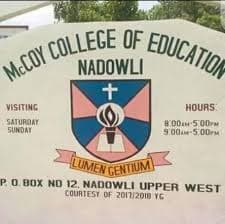
The latest teacher recruitment exercise has laid bare, yet again, the disturbing fragility of Ghana’s public sector systems. What should have been a transparent and merit-based process has instead exposed administrative lapses that are not only inexcusable but deeply unjust, failures that, if left unaddressed, will erode public trust, worsen graduate unemployment, and weaken the very foundations of the education sector.
At the centre of this controversy are graduates of McCoy College of Education in the Nadowli-Kaleo District, who have been effectively locked out of a national opportunity through no fault of their own. The allegation is as serious as it is unacceptable: when the recruitment portal was opened, the name of their institution was missing from the list of selectable colleges, a failure that cannot be dismissed as a minor glitch but must be recognised for what it is: a critical systems breakdown.
For affected graduates, the consequences were immediate and devastating, as confusion quickly gave way to panic and desperate calls flooded the college from applicants who suddenly found themselves excluded from a process that would determine their future. Although the issue was eventually rectified, the response came too late to make any meaningful difference.
By the time these graduates attempted to complete their applications, the recruitment slots had been filled, meaning that a preventable technical omission had already translated into lost livelihoods for qualified young professionals, an outcome that is simply unacceptable in any system that claims to be fair.
The Trial News has gathered credible information confirming that this sequence of events did occur and that delays were encountered in resolving the issue; however, it suggests that the absence of the institution’s name may not have entirely prevented applicants from submitting their applications. But the question is, how can a national recruitment platform fail to recognise a legitimate institution? This is a fundamental flaw which inevitably creates confusion, hesitation, and unequal access in a process that demands clarity and precision.
The burden of such a failure cannot, and must not, be placed on the victims, especially when the error originates from within the very system meant to guarantee fairness.
The Government and the Ghana Education Service (GES) must confront this issue with the seriousness it deserves, as silence, delay, or bureaucratic deflection will only deepen the injustice and reinforce public distrust in state institutions. These graduates are not asking for special treatment; they are demanding what is rightfully theirs, a fair opportunity, and anything less is indefensible.
Immediate remedial action is therefore not optional but imperative, and the GES must, as a matter of urgency, reopen the recruitment portal specifically for the affected graduates, create additional slots, or introduce a supplementary recruitment window to correct this injustice, because failure to act would amount to institutional negligence of the highest order.
Beyond this immediate crisis lies a deeper structural flaw that can no longer be ignored, as the current “first-come, first-served” recruitment model is inherently inequitable, rewarding speed over fairness and pitting multiple graduating cohorts against each other in a race that disregards waiting time, experience, and patience, thereby pushing those who have waited longest further to the margins.
If Ghana is serious about fairness, then recruitment must be aligned with graduation timelines, ensuring that earlier cohorts are given due priority, a reform that would restore order, dignity, and confidence in the process.
Furthermore, the Government must confront a broader and undeniable reality: Ghana needs more teachers, and with persistent gaps in underserved communities alongside rising graduate unemployment, expanding recruitment quotas is not merely compassionate but a strategic necessity for national development.
What has happened to the graduates of McCoy College of Education is not an isolated incident but a defining test of accountability within Ghana’s public institutions, one that will determine whether the system is capable of correcting its own failures or content to abandon innocent graduates to bear the cost of its inefficiency.
The response must be swift, decisive, and just, because the credibility of the recruitment process, and the future of these young professionals, depend on it.
The Trial News






Eunice Zumankyere
Apr 16, 2026 2:28 amThank you for speaking for us. May this get to the people that really needs to see it 🙏
Eunice Zumankyere
Apr 16, 2026 2:29 amThank you for speaking for us. May this get to the people that really needs to see it 🙏